
The inner circle · the living
The World of the Living
Eleven stops, walked in the order the books walk them: a quiet wood, a white city, a mountain hollowed into a fortress, grasslands full of dust and chickens, and a palace that is also a spell. In each one, the people who belong to it.
How to read this chapter
A world you can stand in
He said he was not interested in world-building for its own sake, and he meant it as a criticism. Then he built a Keep that readers still see with their eyes closed. Both are true, and the second is what happens when a cabinetmaker builds a place: he builds it to hold weight.
So his places are mechanisms. Each one has a function, a cost, and a way of failing, and the failure always arrives for reasons the reader was told about hundreds of pages earlier. The Boundary is a lock. The Palace of the Prophets is a clock. The People’s Palace is a spell shaped like a building. The magic has an identity, so the geography has consequences, and walking through it becomes a story.
The map and the cast arrive together here, because a person and their place explain each other. Shota is unintelligible without Agaden Reach, and Agaden Reach is only scenery without Shota. The walk begins where Richard’s does — in a quiet wood on the wrong side of a wall.
The first stop · Westland
Hartland Woods
A country with no magic in it, on the safe side of a wall made of death. That is where the series starts, and the emptiness is deliberate: Richard grows up in the one land where nothing enchanted has been allowed to live, so that the reader meets wonder at the same moment he does.
Richard Cypher
Woods guide, then Seeker, then war wizard, then Lord Rahl
He carves wood. He knows which plants will kill you and which will only make you wish they had. He is curious in the way that gets people into trouble, and stubborn in the way that gets them out. Over eleven novels he is handed every good reason to give up his own life — duty, prophecy, love, mercy, the greater number, the greater cause. He takes each one, and weighs it, and hands it back, having worked out that a life given away as a sacrifice was never anyone’s to take.
Titles keep landing on him — Seeker, Lord Rahl, war wizard, the Caharin — and he keeps refusing to shrink to fit any of them. Read straight through, the eleven books are the education of a will.
George Cypher
Richard’s father, already dead when the story opens
A trader and a wanderer who went places a Westlander was not supposed to be able to go, and came back with things he should not have had — among them the Book of Counted Shadows, the only instructions in existence for using the boxes of Orden safely. He made Richard learn it by heart, word for word, and then destroyed the book, so that the most dangerous text in the world was stored in a woods guide’s head.
Wizard’s First Rule opens with that murder already done, and it is the murder that draws Darken Rahl toward the son. The series begins with a man standing in his father’s ransacked house working out that the safe country he grew up in was never safe.
Michael Cypher
Richard’s brother · First Councilor of Westland
Older, tidier, and in a hurry. Michael collects useful people the way Richard collects plants, and he says outright that information is the coin of power and not a coin to be spent frivolously. When he is made First Councilor of Westland he stands up and warns the crowd about the dangers of fire — which happens to be exactly what Darken Rahl is telling people on the other side of the wall. Richard hears it as concern for the people.
The brother is the first of the series’ betrayals at close range, and Goodkind does not soften what Richard decides to do about it. It is the early warning that the arithmetic in these books runs cold.
Chase
Boundary warden
William “Chase” is a large man, a tracker, and a friend of Richard’s father, and his job is to patrol the edge of a wall made of the underworld as though it were a fence line. It is the flattest kind of courage there is, and he has it in quantity. He later becomes the father who takes Rachel in — a child out of Tamarang who learns that queens, gifts and goodness are three different things, and who is brave in the small practical way children are brave: she keeps walking. Chase’s house is one of the series’ quiet homes, and she is why it matters.
When the Keep is threatened, Chase is the sort of man who goes toward it.
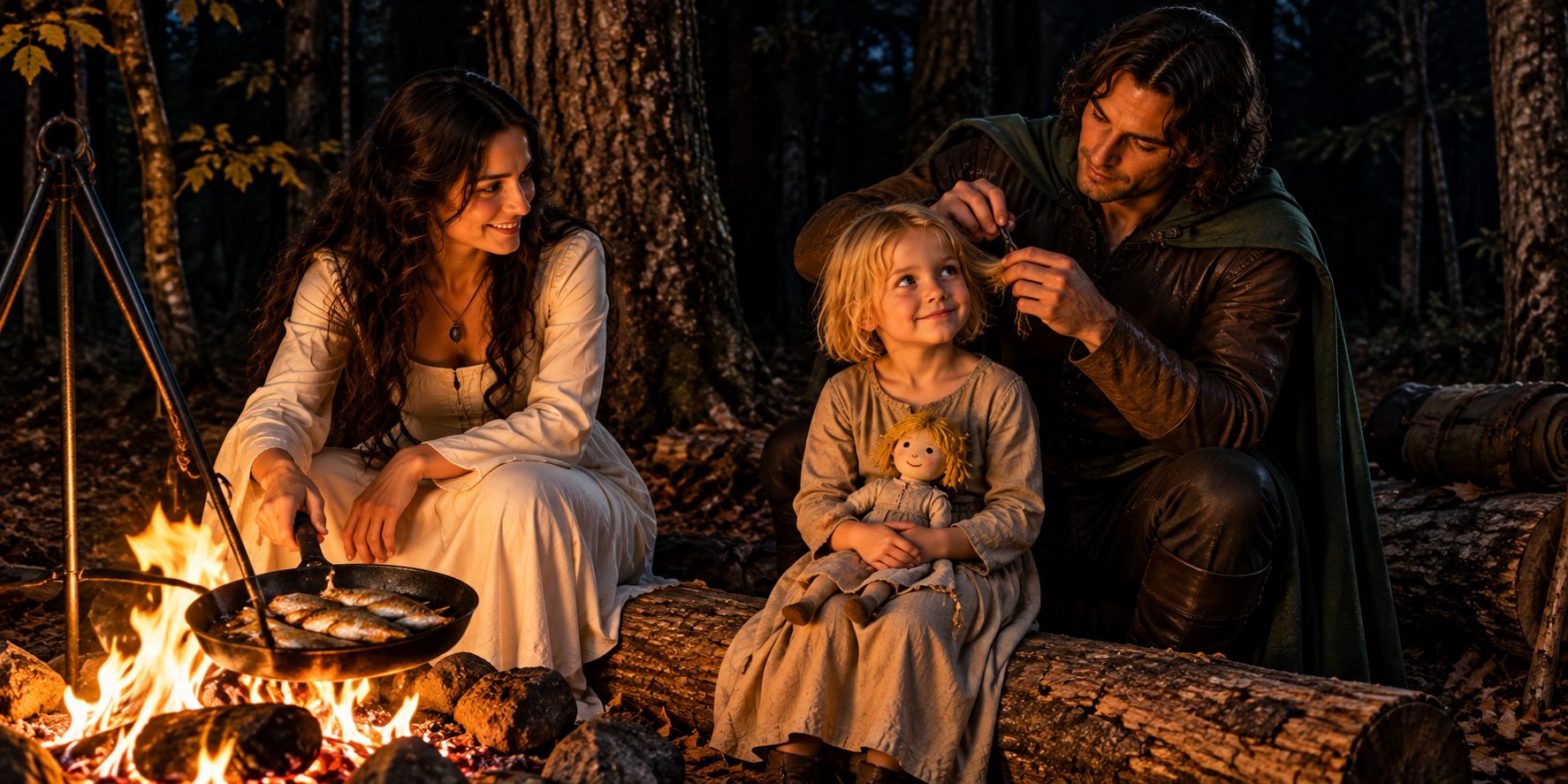
Rachel, and a doll named Sara
Rachel walked out of Tamarang carrying the third box of Orden inside a loaf of bread, and one thing of her own: a doll a wizard gave her that says I love you, Rachel in a tiny little voice. I named her Sara, she tells people. A doll’s got to have a name, you know. Richard is behind her with the scissors, evening up what Princess Violet used to chop jagged for sport, and teasing her until she giggles. Kahlan is the one at the fire.
Adie
The bone woman, of the pass beside the Boundary
Blind, dry-humored, and a sorceress of rare strength, she keeps a house at the edge of the dead wall hung with bones, and she can tell you which of them will hold a thing of the underworld off you. She grew up in Nicobarese, where the gifted were made to swear an oath never to use what they had; she swore it, was lectured on her own wickedness daily, and then broke it to put out a fire a child was trapped in. They whipped her for that, and marched her bloody around the King’s circle.
She is the reason the crossing is survivable, and she goes on being needed for the rest of the series. She is also, eventually, Zedd’s.
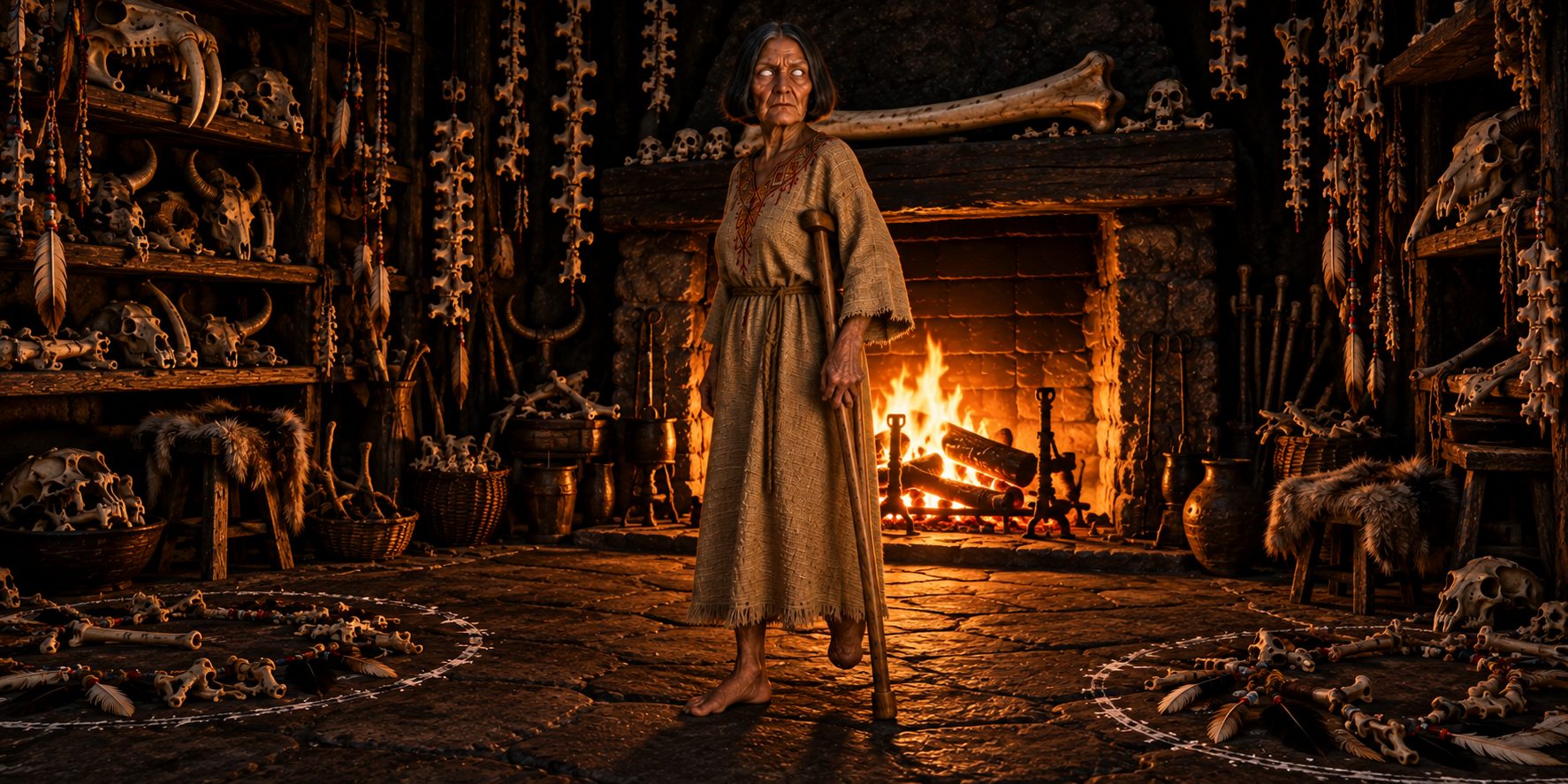
The bone woman’s house, at the edge of the dead wall
The bones are not trophies and not decoration. The bones keep the evil away from here. The beasts cannot find me because they feel the evil of the bones and it blinds them, makes them think I be one of them. She gives one of them away to anyone about to walk into the Boundary: these bones of the dead have the magic to help protect you.
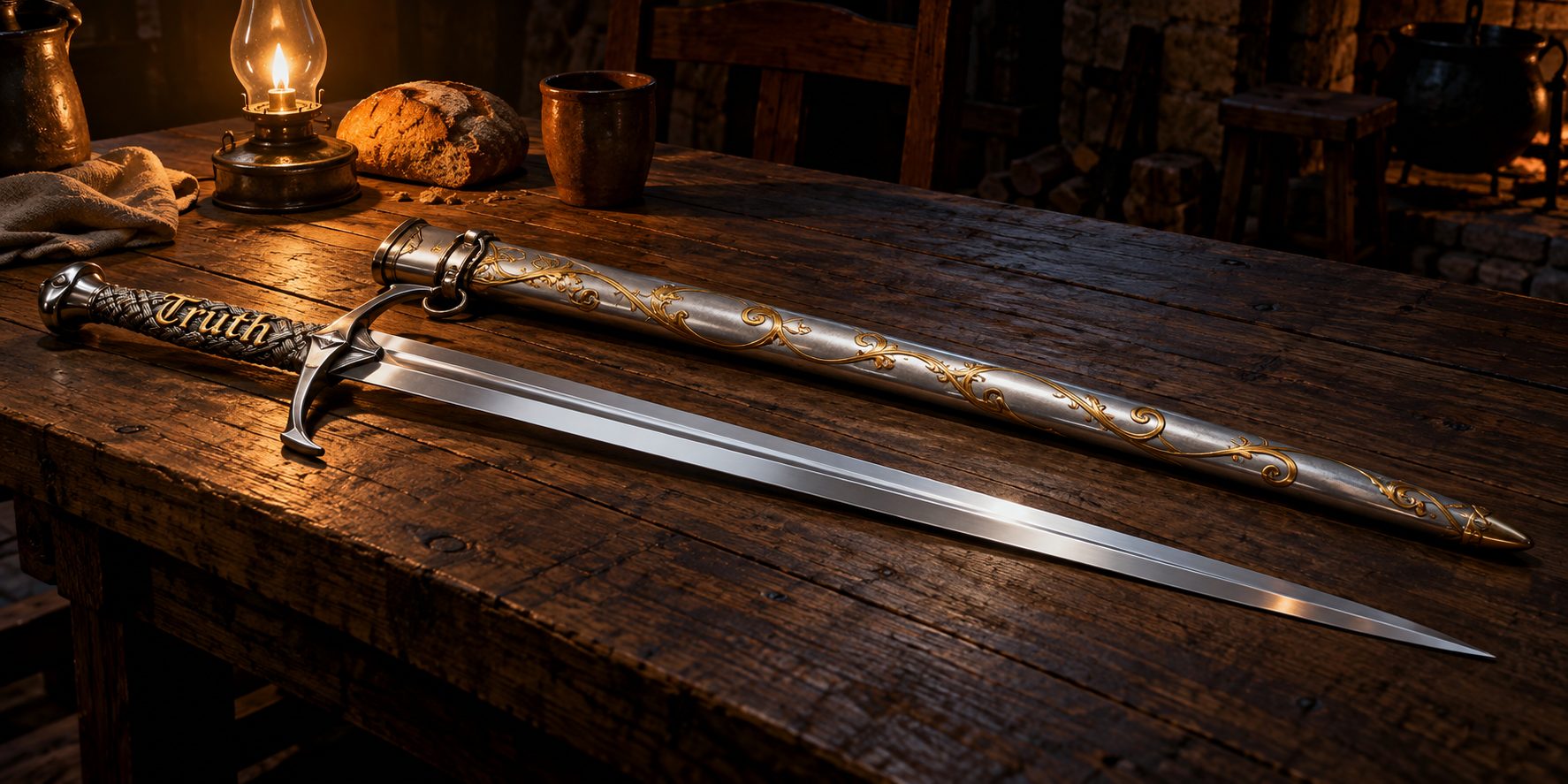
Given at the first stop · carried through all of them
The Sword of Truth
An old man comes round the table and slams something long down in front of a woods guide. This belongs to you, the wizard says. Kahlan turns her back on them both.
What is lying on the table is a silver scabbard, gleaming, with gold flourishes running over it in sweeps and waves. Steel crossguards swept out and down. A grip covered in finely twisted silver wire, and along each side of the braided silver a gold wire interwoven to form one raised word: Truth. This, Richard thinks, is the sword of a king, and the finest weapon he has ever seen.
He draws it, and the blade rings — a sound he has never heard a sword make. The gold letters press into his palm almost painfully. The weight fits him exactly, and something in him comes up to meet a rage waiting in the steel, the twin to his own anger. A part of him is suddenly complete, and that should worry him more than it does.
It runs on what you believe
Then Zedd gives a demonstration, and pays for it himself. Two maples are growing in the yard, planted years ago as a memorial to a wife and a daughter who were murdered. He tells Kahlan that the larger of them was set there by Darken Rahl — the same Darken Rahl who had her sister killed — and when the hate comes up in her he puts the sword in her hands and says: this tree is his; you must stop him. One stroke. A maple that would have cost Richard ten blows with a good axe comes apart with a crack like a thousand twigs snapping at once, hangs in the air a moment, and goes over. Kahlan sinks to her knees with her hands over her face.
It could just as well have been iron, Zedd tells them afterwards; the blade would have cut through it the same. Then he hands the sword to Richard and tells him to take down the little one. Richard, much the stronger of the two, swings with everything he has, and just before the blade lands it simply stops, as if the very air about it had become too thick to allow it to pass. He tries again. The tree is untouched.
The difference is not muscle. “She thought the tree was evil,” Richard works out. “I didn’t.” Kahlan, still white, says the harder half of it out loud: “I destroyed the tree, but it wasn’t evil. It was innocent.” “That, dear one, is the point of the demonstration,” Zedd says. “Reality isn’t relevant. Perception is everything… It won’t allow you to harm someone you think innocent, but it will destroy whoever you perceive to be the enemy, within limits. Only what you believe, and not the truth of your thoughts, is the determining factor.”
So what he has been handed is a weapon of enormous power that answers to the contents of his own head — in a series whose First Rule is that heads are full of things that are false and feel true. There is no safety catch on it either, and Zedd says so plainly: “You had better be sure, my boy, or you are liable to find yourself in a lot of trouble. The magic could read things in your mind you are not even aware of… You could kill a friend, or fail to kill a foe.”
And there is a white blade
There is one way to cut where the sword refuses, and it costs more than strength. To kill someone he does not perceive as an enemy, Richard has to turn the blade white, and what turns it white is love. Late in Wizard’s First Rule he does it, for a Mord-Sith named Denna, who captured and tortured him and who asks him for this. He draws the sword and it does not ring the way it always has. It hisses. A white-hot hiss. He does not look, but he knows the blade has turned white.
What comes through him then is not rage. “All anger, all hate, all malice, was gone.” What is there instead is love for “this innocent, tortured soul, who had been trained to do the things she hated above all else: hurting others.” She takes the tip of the sword and moves it up a few inches. My heart is here, my love. He says, “Forgive me, my love.” She smiles and says, “Everything.”
Afterwards he can hardly carry himself. “Killing with the sword in anger, out of rage and hate, was horrible,” he thinks. “Killing with the sword’s white magic, out of love, was beyond horror.” The blade returns to its polished silver gloss, and he knows how to make it white again, and hopes he will die before it is ever required of him again. He also knows exactly where it will not work: thinking of his brother, he knows he could never bring himself to forgive Michael and make the blade white. Which makes this the Fourth Rule — there is magic in sincere forgiveness — put into a man’s hand as an object, three books before anybody says it out loud.
Only a tool
Zedd keeps it in proportion, because that is his job. “Magic is only a tool, like any other. When you use a whetstone to sharpen a knife, you are simply making the knife work better for its intended purpose. Same way with the magic. It’s just a honing of the intent.” Richard hands it back to him later in his own words: the sword will be invaluable, but it is only a tool, and “the magic of the sword isn’t an end in itself.”
And the post that comes with it was never in anyone’s gift. “Seekers appoint themselves,” Zedd tells Kahlan. “The wizard just sort of recognizes what has happened, and makes it official.” The council had spent years handing the title out as a political bone and never understood what they were handing out: “it wasn’t the post that brought the power to the person, it was the person that brought the power to the post.”
So: a sword named Truth, which will not cut what its owner believes to be innocent, and turns white only for love, given to a man who is about to spend eleven novels working out what he actually believes. It is the whole series in one object, and Goodkind put it on the table in book one.

The second stop · the Midlands
Aydindril
The white city at the center of the Midlands, where the Confessors’ Palace stands in sight of the Keep on its mountain. Lands send tribute here. The Mother Confessor outranks kings, and what she rules with is a touch of her hand.
Kahlan Amnell
Mother Confessor of the Midlands
She wears white among Confessors who wear black. Her power is a touch that takes a person’s will away with love: after it, they belong to her, wholly and without pretense, and will tell her anything true. It is the most invasive magic in the books and Goodkind never lets it be comfortable. Using it costs her; the person she touches is not free again in any ordinary sense; and the old wizards made Confessors anyway, because they had decided that the truth, when it truly matters, has to be fought for.
She is a ruler first, and the other half of the theme. The Chainfire books put that to the hardest possible test — a spell erases her from the memory of the world, so that she is alive and no one but Richard can hold on to the fact of her — and her answer, even without her own memories, is to keep fighting.
Neither of them was drawn from anybody. Asked what real people stood behind Richard and Kahlan, Goodkind said: “There were no such people. I created them both. I wanted them to be the kind of people I look up to.” He put it at more length in 2007. “They think like I do because they’re my heroes,” he said. “They are people I admire and look up to, and I have them reflect the kind of thinking that, to me, is heroic thinking.”
Magda Searus
The first Confessor
Three thousand years earlier, an ungifted woman in the middle of the Great War loses her husband and walks, grieving, straight into the founding of the order. The Confessors, the Sword of Truth itself, the shape of the world Richard inherits — all of it starts with someone who had no gift and decided to act anyway. Without Magda there is no Kahlan. The First Confessor is where the whole shape of it starts.
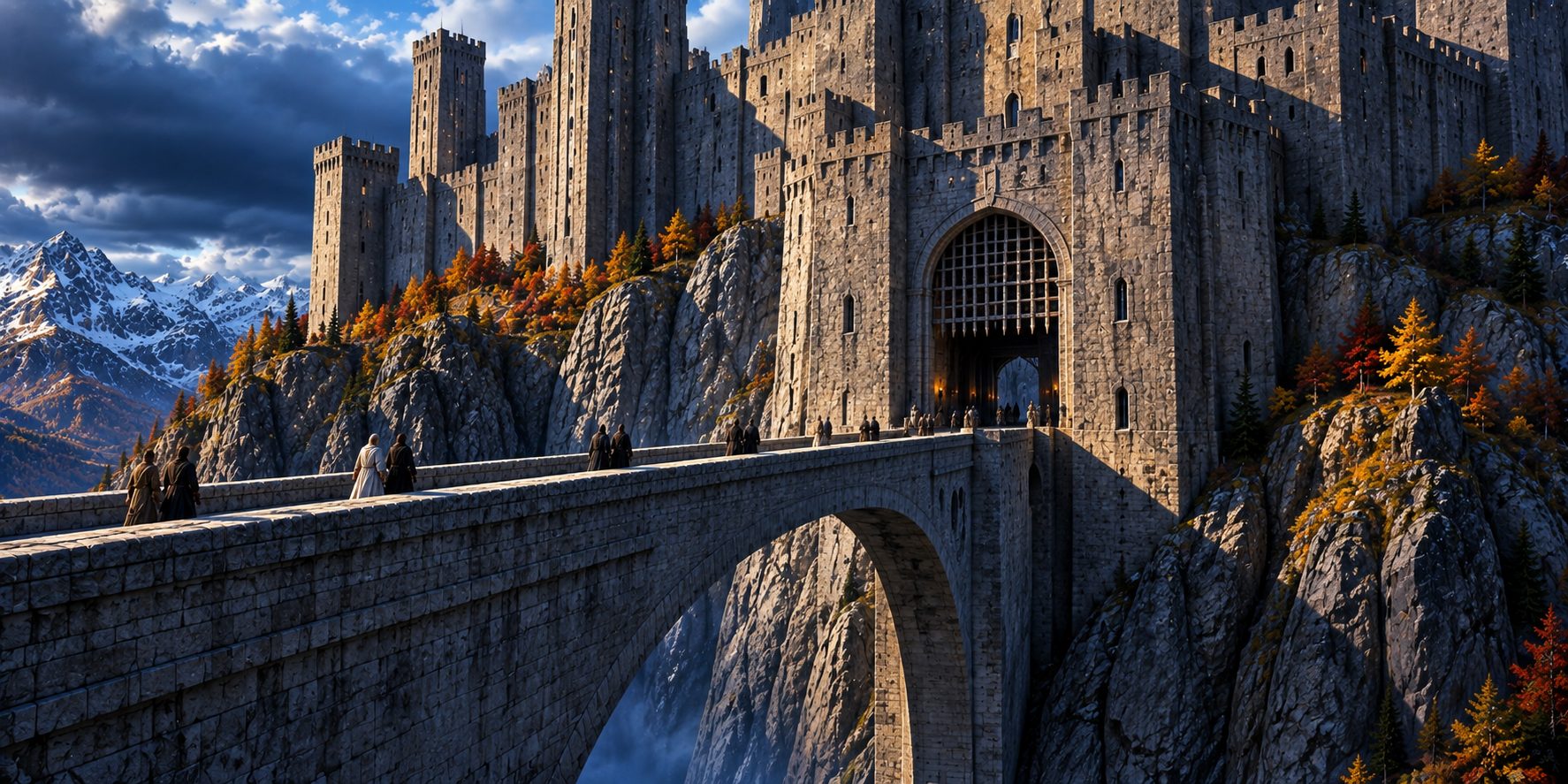
The third stop · above Aydindril
The Wizard’s Keep
Carved into a mountain until the mountain is the building. Thousands of rooms. Shields older than the men who still walk there, and magic radiating out of the stone itself. Vast, strange, and still on duty.
Some doors in the Keep will not open for anyone lacking subtractive magic, which means Richard can go where Zedd cannot. The architecture knows the rules, and so the rules decide who may walk where. Whole chapters turn on a door.
Inside are the sliph’s well, libraries nobody has finished reading, the containment fields of the great war, and the private business of First Wizards going back three millennia. The Keep is meant to stop you on the page the way a cliff stops a horse.
Zeddicus Zu’l Zorander
First Wizard · Richard’s grandfather
He looks like a scarecrow with a grin, wears a plain robe, loves bag stew and a good joke, and is one of the most dangerous men alive. He raised the boundaries. He raised the boy in the woods. He teaches the rules and then breaks them when the situation demands it, which is itself one of the teachings.
Without Zedd there is no Seeker, no First Rule spoken out loud, and no Keep still standing in the reader’s head. He is the old world talking to the new one and cheerfully refusing to become a statue about it.
Kolo
A wizard of the great war, three thousand years dead
His journal is found walled up in the Keep, and the living are still learning from it. The Third Rule and the Fifth come out of those pages. It is a lovely piece of design: the Keep is full of rooms, and some of them still speak, and the dead wizard who left the notes had no idea who would need them.
Berdine
Mord-Sith · translator of High D’Haran
Kolo wrote in a language Richard cannot read, and Berdine can. So one of the great turns of the middle books is a Mord-Sith and a Lord Rahl sitting up late over a dead man’s handwriting, arguing about grammar, while a war waits. She is blunt, literal, and funnier than she intends to be.
She loved Raina, another Mord-Sith, and lost her to the plague. The books let that grief stand exactly as it is, without explaining it or making a lesson of it, and Berdine goes back to the books because the work is still there to do.
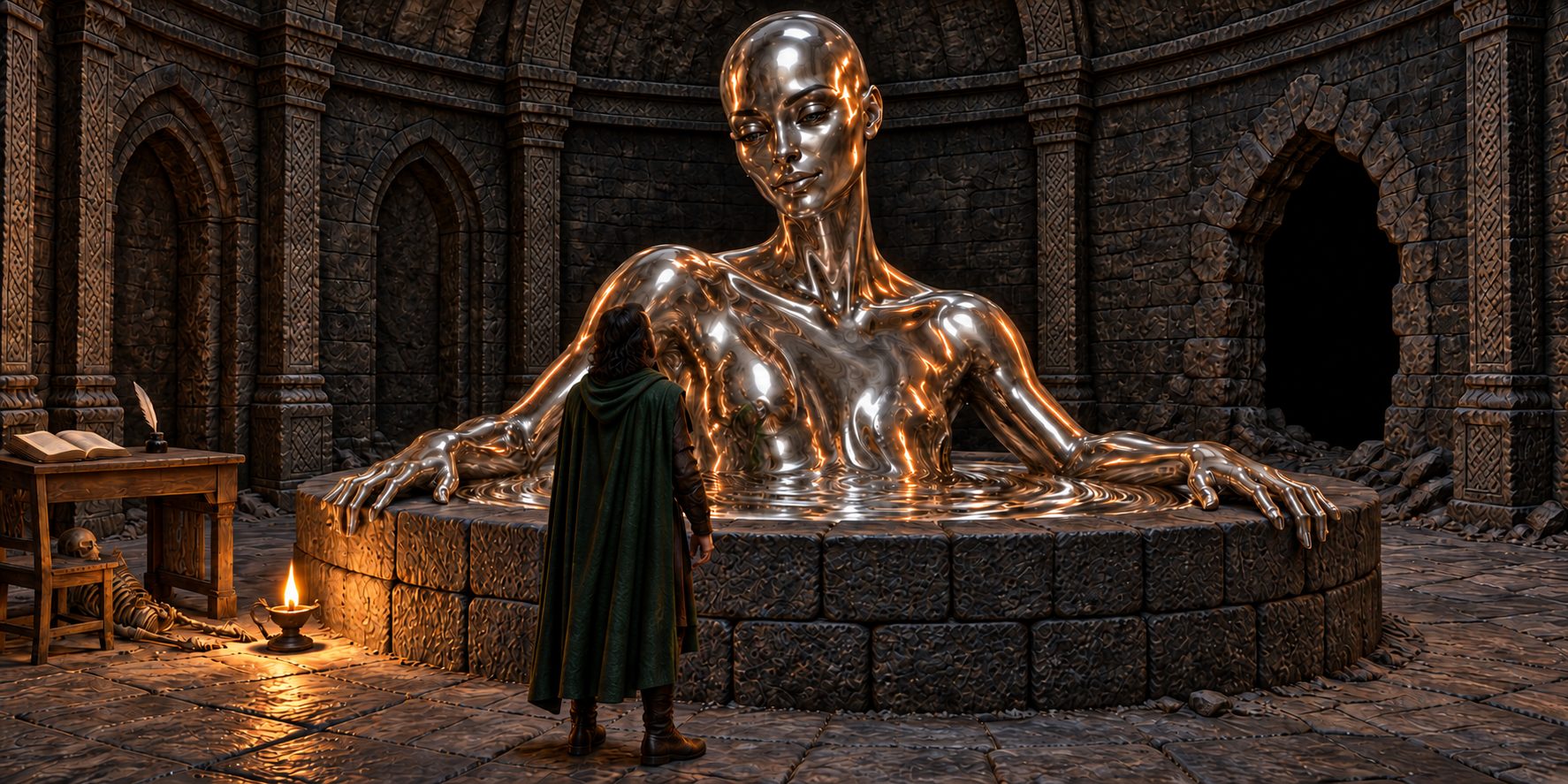
Do you wish to travel?
That is the Sliph, risen out of her well under the Wizard’s Keep, and the caption is what she says. She is quicksilver, and she was a woman before wizards made her into a road. Answer yes and you stop breathing air and breathe her instead, for as long as the thousand miles take.
The fourth stop · the well beneath the Keep
The Sliph
Not a person, and not quite a place. A traveling thing of quicksilver and old magic, made by wizards of the great war out of a woman who did not entirely stop existing. She waits in a well in the Keep, and if you have both sides of the gift and know the words, she will ask whether you wish to travel, and then carry you a thousand miles in the time it takes to stop breathing.
Because you do stop breathing. You draw her into you instead, and she remembers, and she is not always pleased with the living. To ride the Sliph is to trust a river that has a mind and a history and opinions about what you are for.
This is the register the books live in: wonder that is genuinely wonderful and genuinely dangerous, at the same time and for the same reason. Everything here has a price printed on it, and the price is usually the thing you were counting on keeping.

The fifth stop · the oldest Midlands
Agaden Reach
Shota’s country. Trees, water, and a path that feels like a throat. Legend says even wizards fear to walk in. The place is alive, and far too interested in you.
Shota
Witch woman of Agaden Reach
She sees what others will not pay to hear, including futures that look exactly like betrayals. Kahlan, guiding Richard in, is covered in illusory snakes for the crime of being Mother Confessor on Shota’s ground — which tells you most of what you need to know about the local hospitality.
She is the one who puts the Fourth Rule to Kahlan — that there is magic in sincere forgiveness — and she is careful about it in a way a kinder character would not be: spoken forgiveness without the real thing is theater, and she says so. Shota is honest on her own terms, and she is nobody’s. That combination is rarer than witches are.
Samuel
Shota’s companion · the Seeker before Richard
A small gray skittering creature with arms too long for him, who was once a man, and who once held the Sword of Truth — he got it by cutting the previous Seeker’s throat. He came to Shota afterwards desperate for help, and there was none she could give him; what she had to offer was pity, and she gave him that instead. He wants the sword back with every part of himself that is left.
He is a question the books ask without stating it: what becomes of someone who carries that sword without the character to carry it. Richard meets one of his own possible endings crouched in the dirt at the witch woman’s feet, drawing circles with his fingers.
Six
Another witch woman, of the later books
There are two of them, and they are not the same woman. This world has more than one woman who will not be ruled, and Goodkind kept writing them; Six is what the same power looks like with none of Shota’s restraint.
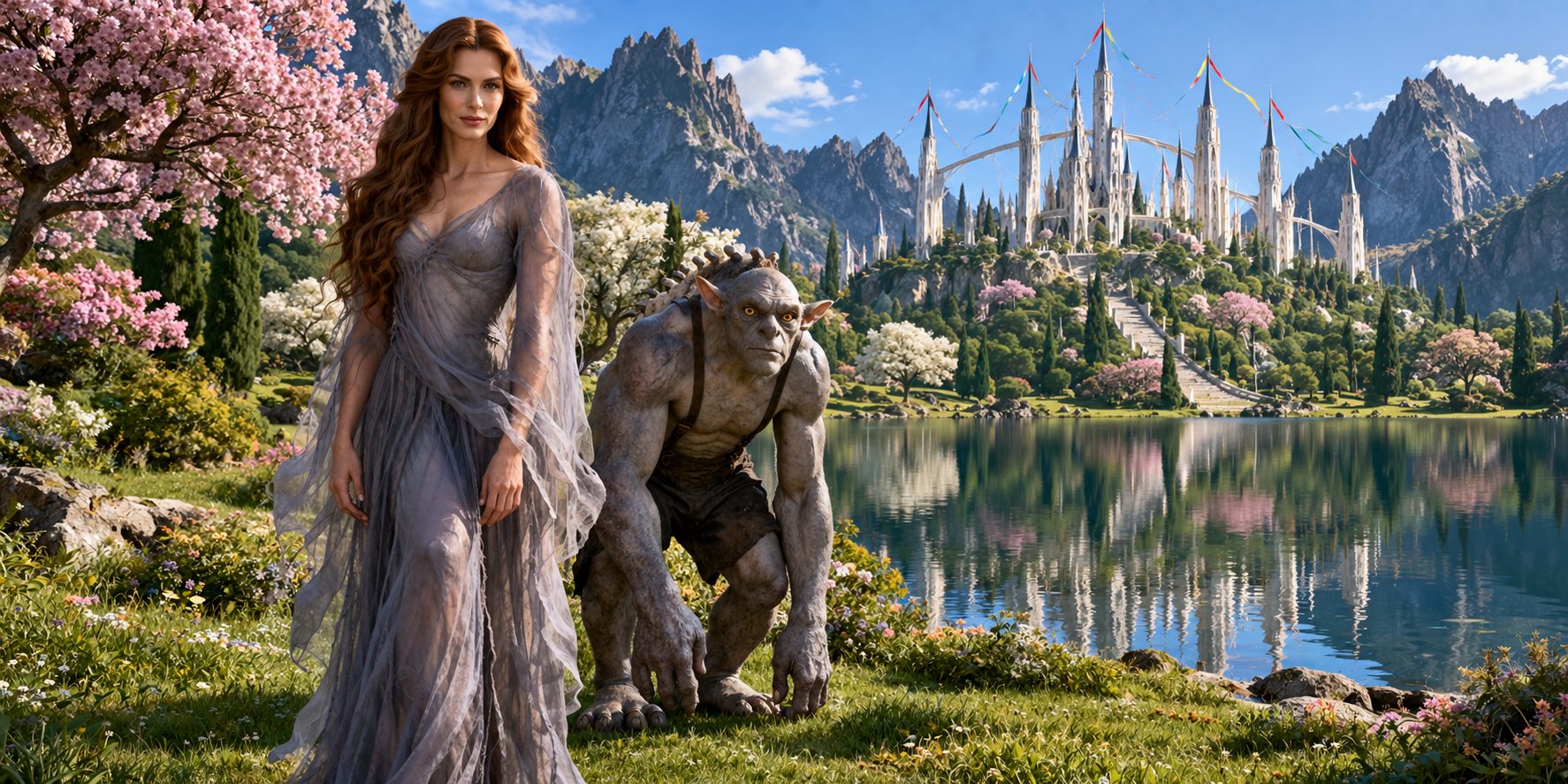
Shota on her own ground, and Samuel at her heel
The small gray creature behind her is Samuel, who was the Seeker before Richard and carried the same sword. He was a man when he started. Zedd took the sword off him, and the magic of it is what left him like this. The palace across the water is Shota’s, in the valley legend says wizards will not walk into.
The sixth stop · the grasslands of the Wilds
The village of the Mud People
A ring of mud-brick houses on a rise that barely counts as a hill, plastered tan, roofed with grass that leaks the moment it dries and has to be replaced again. Chickens everywhere. In dry weather the whole place is a fog of dust that gets into your eyes and your mouth; in the wet, a thousand footprints turn to puddles with the drab buildings reflected in them. No glass in the windows. Cloth, where anyone bothered.
It is the plainest place in the series and one of the most important, because it is where the books stop being a quest for a while and become about belonging. The Mud People do not care about anyone else’s war. They want to be left alone, they are dangerous when they are not, and an adult will not smile at a stranger until greetings have been exchanged, in case his soul is taken. Richard and Kahlan do not conquer them or persuade them. They are adopted, which takes longer and costs more.
The spirit house, and the gathering
Behind the communal buildings stands a windowless room with a small fire at one end and a plank shelf along the wall holding two dozen ancestral skulls. That is the spirit house, and what happens in it is a gathering: the elders call the spirits of their ancestors into the room and ask them questions that matter to the living. It takes three days of banquet and preparation to hold one, two if the world is ending. No outsider attends, and no woman — except when the rule is set aside, which is how Kahlan comes to be sitting in the dark with the dead.
The gathering is the world’s one reliable call to the other side of the veil, and the books use it as exactly that: Richard learns where the last box of Orden is in that room, while Darken Rahl circles the village overhead on a red dragon and cannot find him, because a gathering hides what is inside it.
The Bird Man
Leader of the Mud People, in fact if not in title
Silver-gray hair to his shoulders, a weathered face, a buckskin tunic, and a carved bone whistle on a leather thong at his neck. He blows it and no human hears a thing, and then the birds he wanted arrive. The six elders are the visible council; he is the one who decides, and he presides over the gatherings.
When Richard and Kahlan first stand in front of him, he does the thing almost nobody in these books does: he takes the measure of two strangers, concludes they mean well, and then helps them argue their case to his own elders. He is a study in the kind of authority that does not need to raise its voice.
Savidlin, Chandalen, Nissel
The Mud People greet each other with a slap to the face, hard, to show respect and prove that no one is hiding anything. Savidlin greets Richard that way and Richard knocks him flat, and that is the beginning of the friendship. Savidlin wants to know how Richard makes a roof that does not leak; Richard teaches him, without a shared language, and there is a house in that village with a good roof on it because a Seeker of Truth once stopped to lay tile.
Chandalen leads the hunters who keep outsiders out, inherited the job from a grandfather who taught the Mud People how to kill, and does not want Richard there at all. Nissel is the village healer, stooped and nearly silent, who smiles at odd moments and is kinder than anyone she treats understands at the time.
And when Richard and Kahlan finally marry — after the plague, after the winds, after everything — they do it here, in a small ceremony among the Mud People, in the dust, with the chickens. Not in Aydindril. Not at the People’s Palace. Here.
The seventh stop · overhead
A dragon, and a gar
Two friendships that are not human, in a series that is quietly always asking what a person is. Richard does not tame either of them. He strikes a bargain with one and refuses to kill the other, and both are choices he has to keep making.
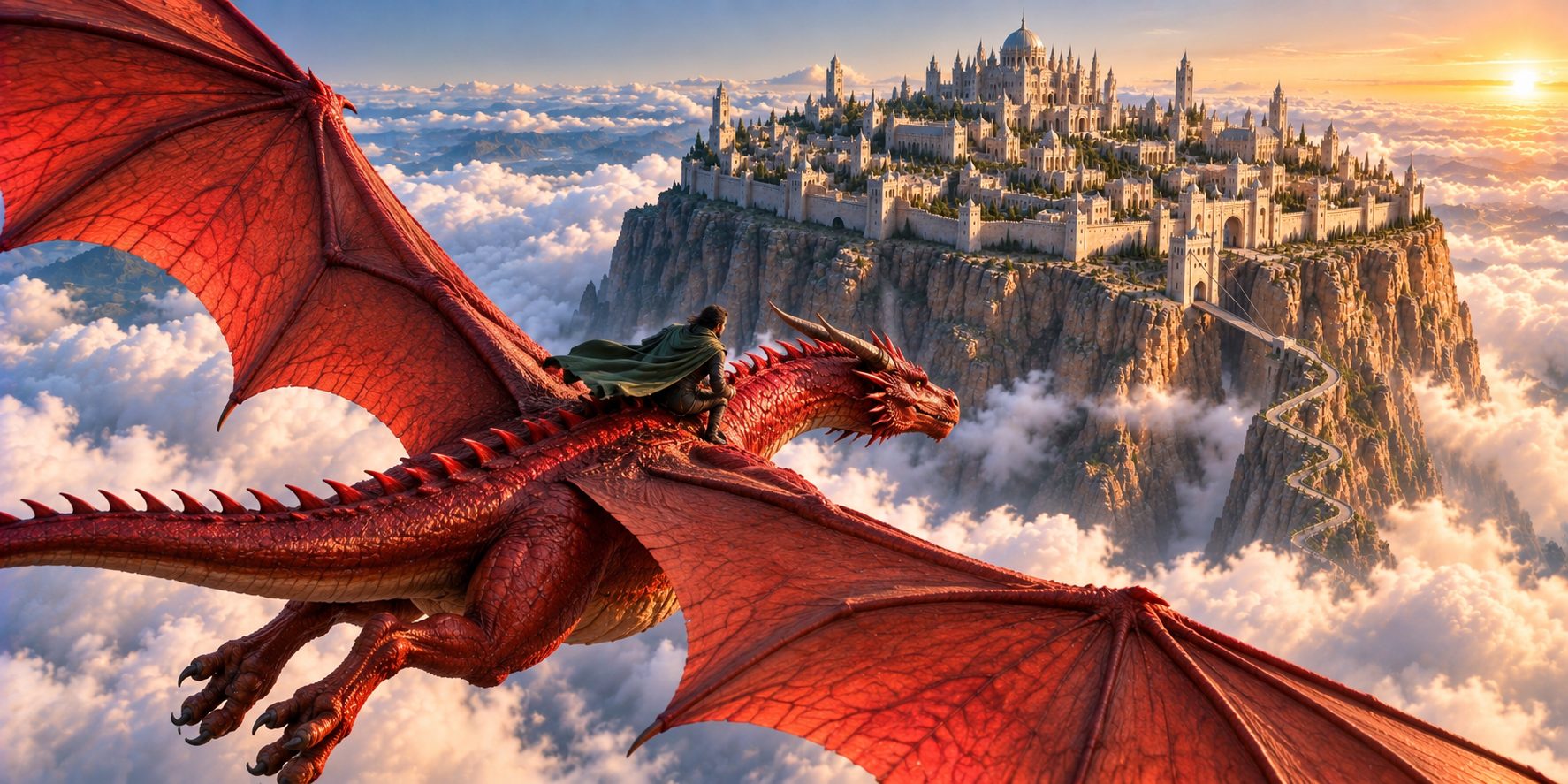
Scarlet
A red dragon
Rare, reasoning, and nobody’s pet. She has a hatchling, a temper, and bargains she expects you to keep. Richard never tames her. He strikes a deal with her, and then he keeps it.
There is a law underneath her, too. Dragons exist by magic, so if magic dies, dragons die with it. When Soul of the Fire lets the chimes loose in the world, the sky begins to empty out. The loss of wonder in that book is literal, and it is the plot.
Gratch
A gar
Something between a great ape, a bat and a nightmare — blood flies riding his belly, claws enough to open a horse — until Richard refuses to kill him, feeds him, names him, and the nightmare turns into a friend. Short-tailed gars are the clever ones. Gratch is clever, lonely, and entirely loyal.
Friendship, in these books, is a fact rather than a speech. Most of what passes between Gratch and Richard is not language at all, and none of it needs to be.
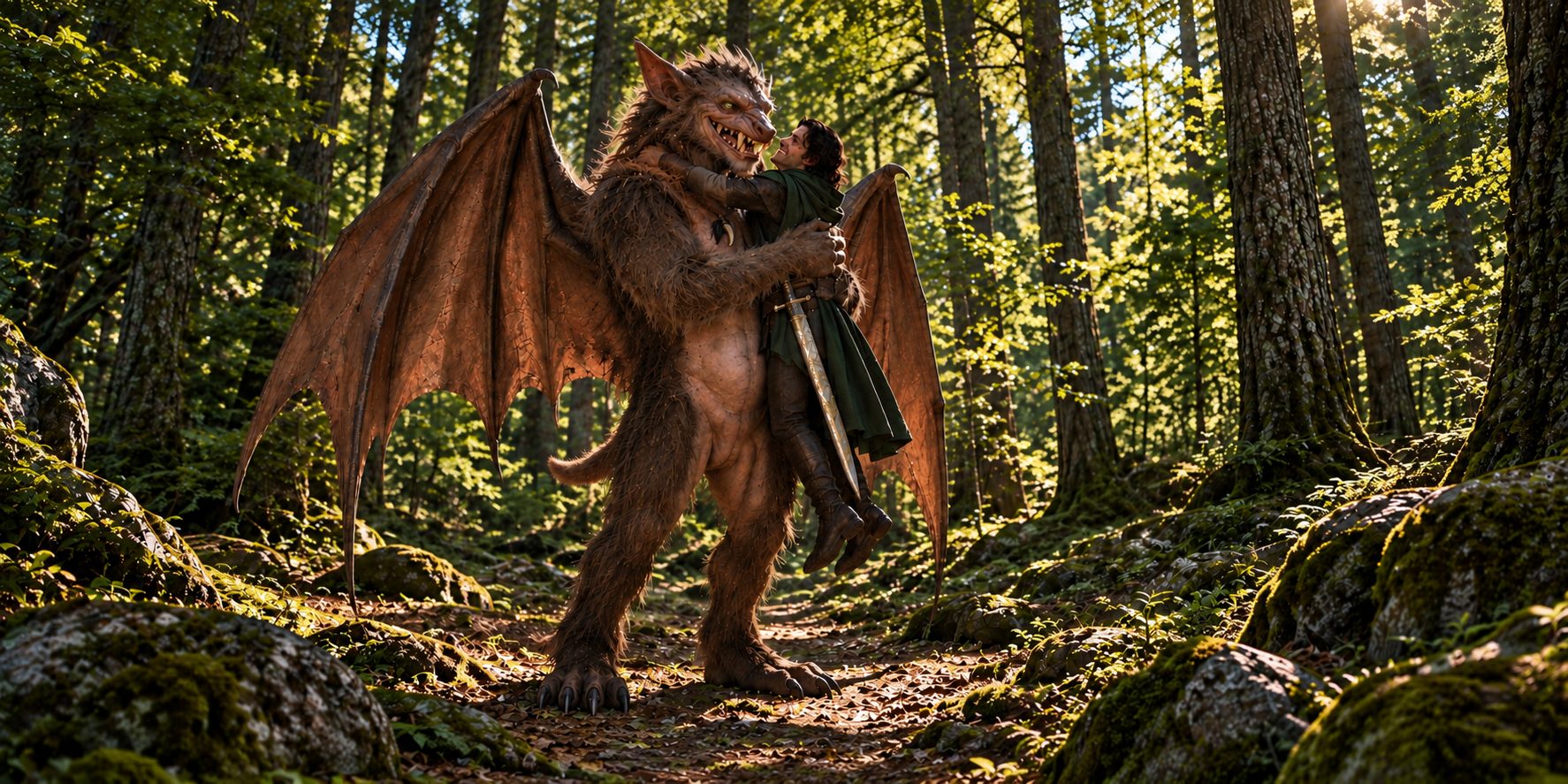
Grrratch luuug Raaaach aaarg.
That is the caption spelled the way the books print it, and it is the most a gar’s mouth can manage of Gratch loves Richard. Richard’s answer never varies: I love you, too, Gratch. On the thong at his neck are Scarlet’s tooth and a lock of Kahlan’s hair, which Richard gave him so he would know the woman his friend loves.

The eighth stop · D’Hara
The People’s Palace
A city on a plateau, pretending to be a building. Granite terraces, corridors that smell more of flowers the higher you climb, and the Garden of Life at the heart of it. It is also a spell: a great constructed magic that gathers power to the House of Rahl and dampens everyone else’s gift.
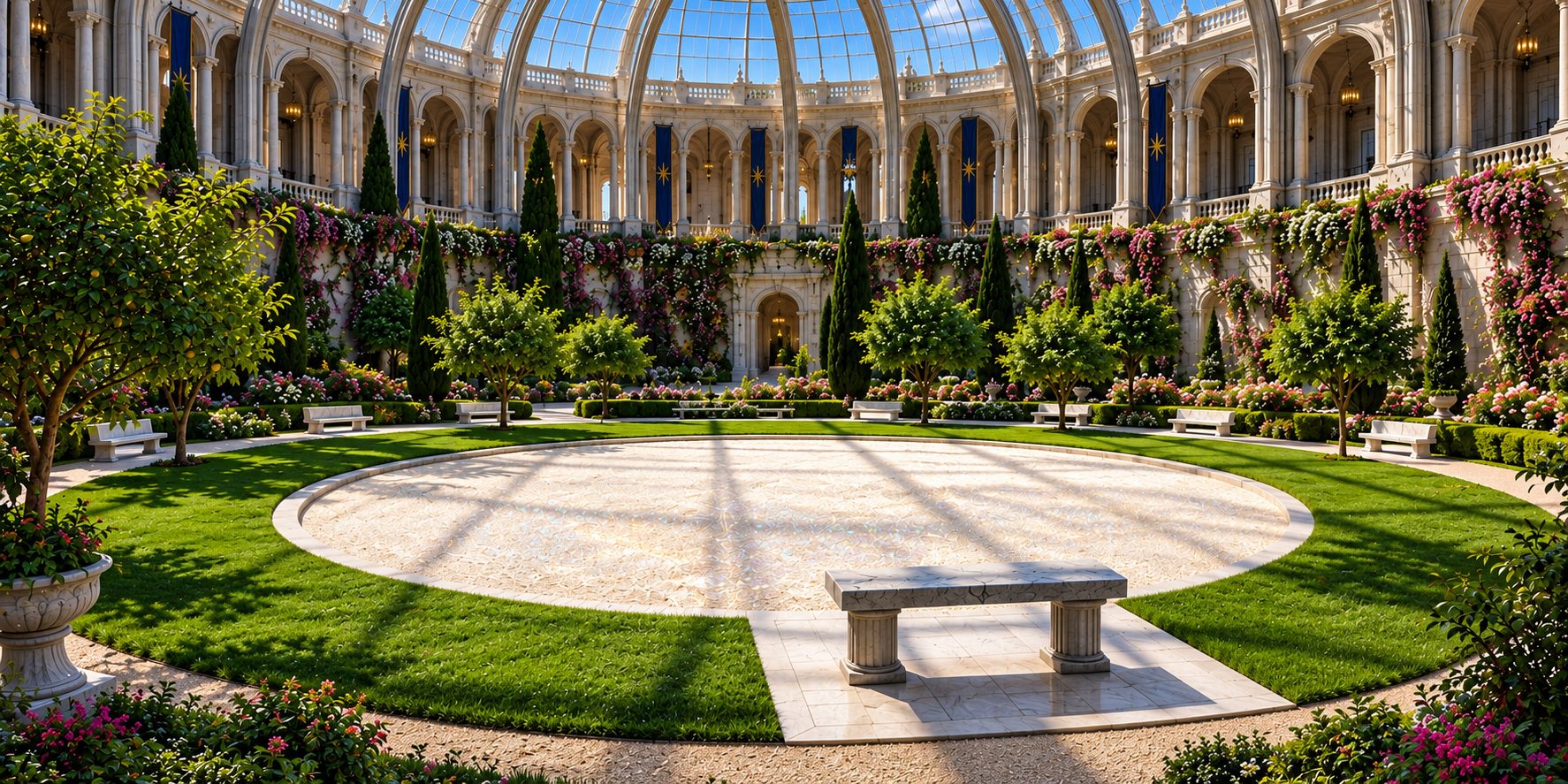
At the top of the plateau
The Garden of Life
Lawns, gravel paths and flowering vines under a glass roof, high inside the palace, with a circle of white sand at the center of it and an altar standing in the circle. It is a garden, and it is also the room where the worst things in the series are attempted.
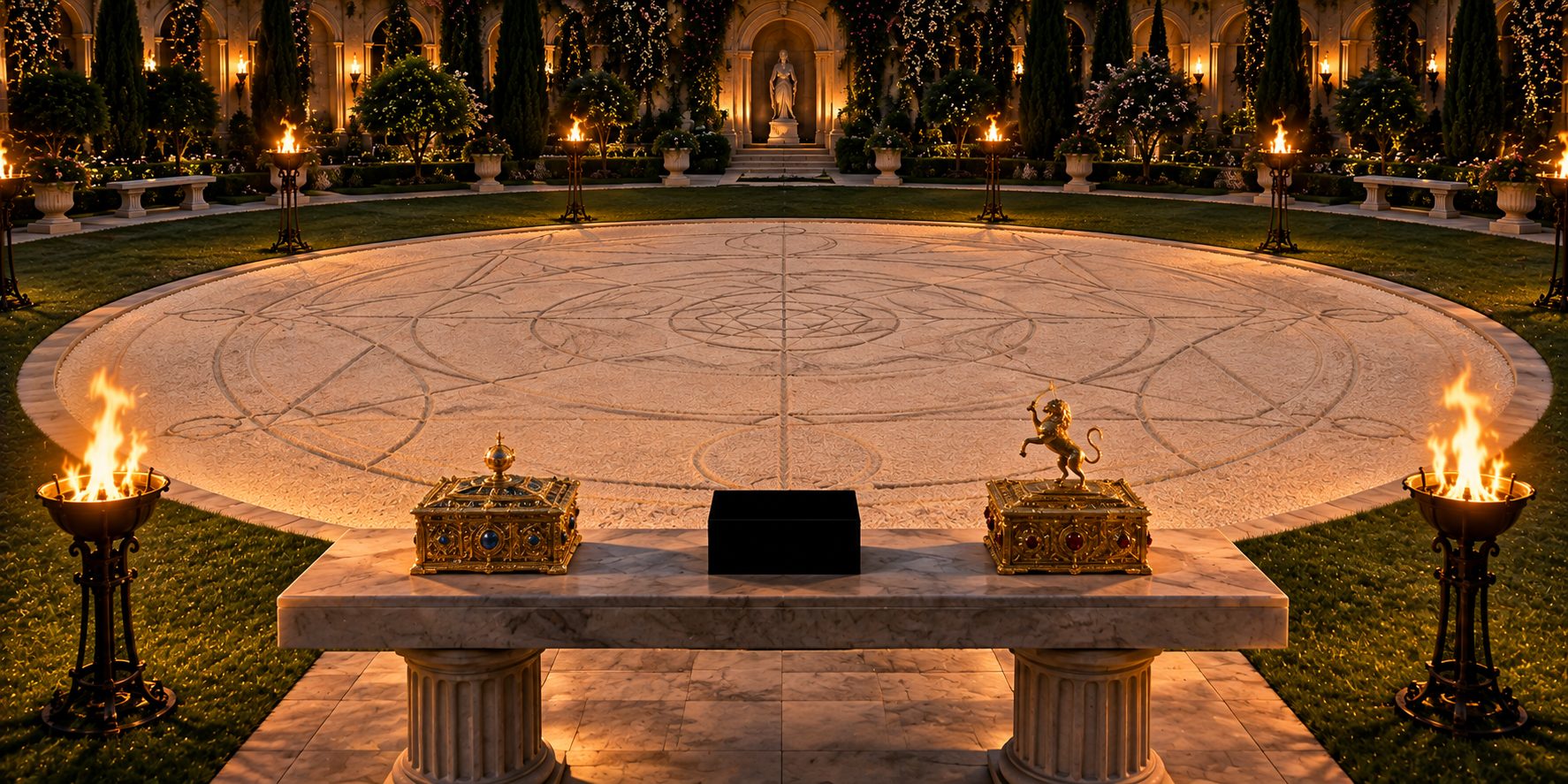
The three boxes of Orden, on the altar
Two of them still have their jeweled covers on. The third is the box itself, and that is its real color: as black as the night stone, its surface a void in the light of the room. One of the three grants the world, one destroys the man who opens it, one kills everything. Which is which is told by counting their shadows, and one shadow is too few and three more than all life can bear, so the balance is struck by opening the box with two.
Darken Rahl
Lord Rahl of D’Hara
The first great shadow on the series, and a genuinely frightening villain: patient, elegant and clever. He knows the Wizard’s Rules and uses the First with both hands: give people an enemy, a purpose, a fear or a wish, and they will march. He performed his rites in the Garden of Life. He is named once here because once is enough — the books already spent him well.
Denna
Mord-Sith · the hardest chapter in the first book
Mord-Sith are chosen out of the gentlest and kindest girls in D’Hara, on the reasoning that the kind ones have the farthest to fall. Denna was one of those girls. Darken Rahl hands Richard to her to be broken, and she breaks him, and she is better at it than any of the others, and she tells him so.
Then something the training was built to remove comes back in her, and she spends her own life to set him free. Richard wears her Agiel around his neck for the rest of the series. It hurts him every time he touches it and he keeps it anyway, which may be the most Goodkind moment in eleven books: mercy is not a feeling you have, it is a weight you agree to carry.
Cara
Mord-Sith
Red leather, a braid, an Agiel that hurts her as much as anyone she touches with it. The Mord-Sith were made by breaking girls until they could break wizards, capturing the gift of anyone who used magic against them. Cara is what happens when that training meets a Lord Rahl who refuses to be a tyrant in the old style and simply keeps treating her as a person until she cannot unhear it.
She is funny, vicious, and fiercely alive, and her loyalty is never the simple kind. When her wedding finally comes, it is one of the series’ quiet victories: people who have been used as weapons can still choose a future.
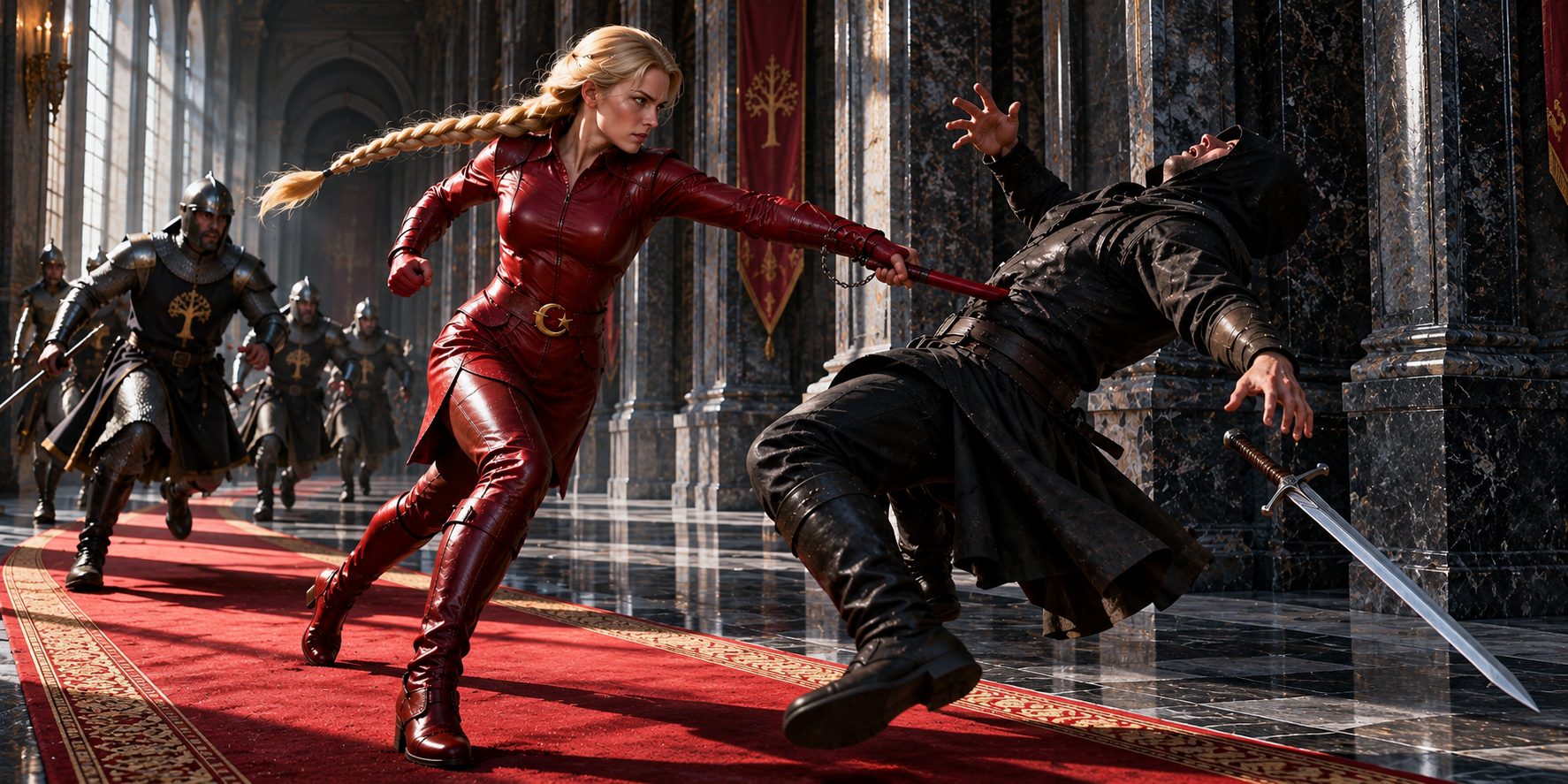
Cara, between the Lord Rahl and whatever comes for him
The short red rod in her fist is the Agiel, hung from her wrist on a fine gold chain and never taken off. This is the Agiel, Denna told Richard, and then showed him what it does. A touch of it is pain past bearing, and it is the only weapon a Mord-Sith carries.
Jennsen
Richard’s half-sister · a hole in the world
Darken Rahl’s daughter, born without the least spark of the gift. The old texts have a name for it: a pillar of creation, a hole in the world. Magic cannot touch her, and more unsettling, magic cannot see her. Her father hunted his own ungifted children, so she spends her childhood running, and arrives believing Richard is the monster she has been told about all her life.
She works it out for herself, by reasoning. And she does something no amount of prophecy manages: she makes the rules of this world show their edges, and the people standing on those edges turn out to have been people all along.
And then the words stop
Twice a day, for generations, D’Harans knelt on those steps and recited a devotion to the Lord Rahl — in your light we thrive, in your mercy we are sheltered, your wisdom is our shield. The stone is unchanged at the end of the series. The spell is unchanged. What changes is that Richard tells them the words are no longer required.
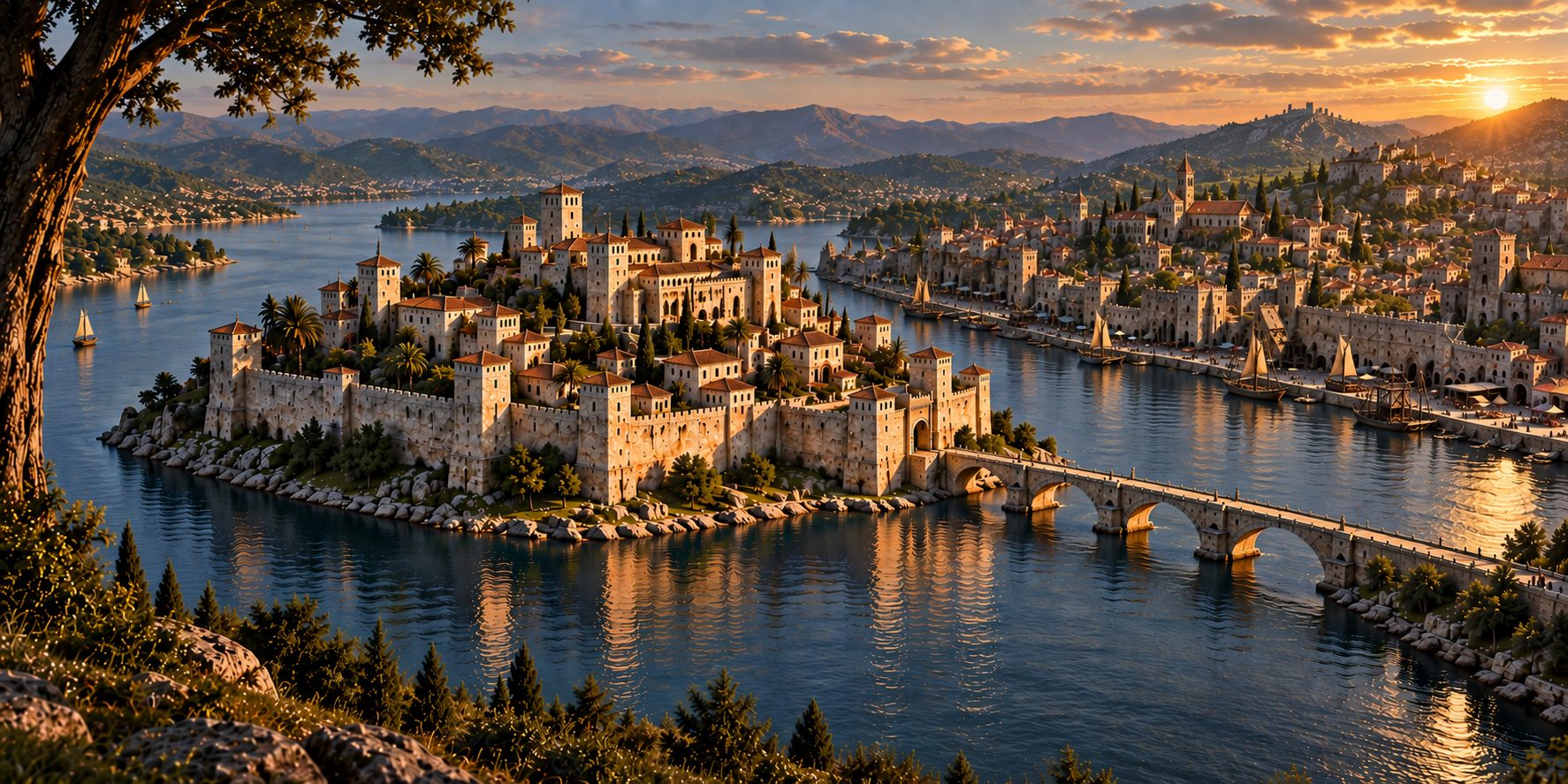
The ninth stop · the Old World
The Palace of the Prophets
Halsband Island, near Tanimura. Home of the Sisters of the Light, who bring young wizards here to be trained — sometimes against their will — and named for what is kept underneath it: vaults full of written prophecy, and one living prophet, collared and not let out.
A spell of time lies over the whole island. It is why the Sisters are never in a hurry, and why nobody outside these walls can afford to wait for them.
Over the whole island sits a bifurcated web of additive and subtractive magic that slows time for everyone inside it: a year of your life spent here can cost you ten outside. Novices come in as children and leave to find their families dead of old age. Wizard’s fire is forbidden within the walls, because it might light the web.
That single piece of machinery does an enormous amount of work in the novels. It makes the Sisters patient in a way ordinary people cannot be, it makes their certainty about the future feel earned, and it makes their mistakes expensive in a currency nobody else is paying.
Prelate Annalina
Head of the Sisters of the Light
Formidable, loving, manipulative, and not always right. Ann has read prophecy about Richard’s life and believes she understands it better than he does, and she is prepared to arrange decades in order to serve that reading. Goodkind lets her be wrong without letting her be a fool, which in these books is a form of respect. Verna follows her, and inherits the problem.
Nathan Rahl
Prophet · a Rahl, and a thousand years old
Taken by the Sisters at four years old and kept here ever since: behind shields, in a collar, with the finest wine they could bring him and no door he was allowed to use. Nathan is charming, improper, thoroughly unimpressed, and dangerous for one reason — he tells people prophecies they were not supposed to hear. Ann, who kept him, wrote of him in her journal: he is a one thousand year old child. She is also the person he eventually walks out of the Palace with.
He is the best joke Goodkind plays on prophecy. A thousand years of the stuff, in the custody of a man who mostly wants a sword and a horse.
Verna, and Warren
A Sister of the Light, and the young man in the vaults
Verna is sent out of the Palace with orders to find one boy and bring him back. It takes her twenty years on the road, and she comes home to find out what the Palace has been doing with her obedience. She becomes Prelate after Ann, and she is the character in these books who most clearly earns her authority by having been wrong first.
Warren lives in the prophecy vaults. The others call him Mole, and he decides to like it, because “a mole can find its way in the dark, where others are blind.” He looks like a man in his twenties and is over a hundred and fifty, because the spell over the island has been quietly spending his years for him. He and Verna find each other very late, and he does not live to see the end of the war.
Du Chaillu
Spirit woman of the Baka Tau Mana
Not of the Palace — of the country around it. Richard finds her a captive of the Majendie, badly used, and frees her. She takes him to her own people, and there she orders thirty of their blade masters to attack him, five of whom are her husbands, because that is the test her people have spent three thousand years preparing. He survives it by finding something in the Sword of Truth no Seeker had found before, and she then informs him that he is the Caharin: the leader of her people, and her husband. He declines. The spirits, she explains, do not much care what he thinks.
She is one of the funniest and least sentimental people in the series, and her nation’s name changes because of him: Baka Ban Mana, those without masters, become Baka Tau Mana, those with a master.
The Sisters of the Dark
The other half of the Palace’s education
Sisters who took the Keeper’s bargain: subtractive magic now, and a master in the underworld afterwards. Nicci was one of them. The books never pretend the bargain was a costume, which is exactly why her later chapters land.
What happens to the Palace itself is one of the series’ hard choices. Some beautiful things are also weapons, and cannot go on being both.

Across the square · the veil
What comes from the other side
The Grace has a square in it for a reason. Beyond the world of the living is a membrane, and beyond the membrane is the Keeper, and a great deal of this world’s trouble is a question of how well that seam is holding.
The veil is kin to the Boundary: the same dark asked to do a different job, holding the underworld back from the living instead of holding two countries apart. When the boxes of Orden are opened, that lock fails, and what comes through does not need to be evil to be catastrophic. It only needs to be dead and in the wrong place.
Jagang
Emperor of the Imperial Order · a dream walker
Black eyes, an army that believes itself virtuous, and a mind that can walk into yours and sit down. He is the long war after Darken Rahl, and a much colder idea: a movement that has convinced itself the individual is the sin. Whatever Richard holds to over eleven books, the Order has a doctrine against it.
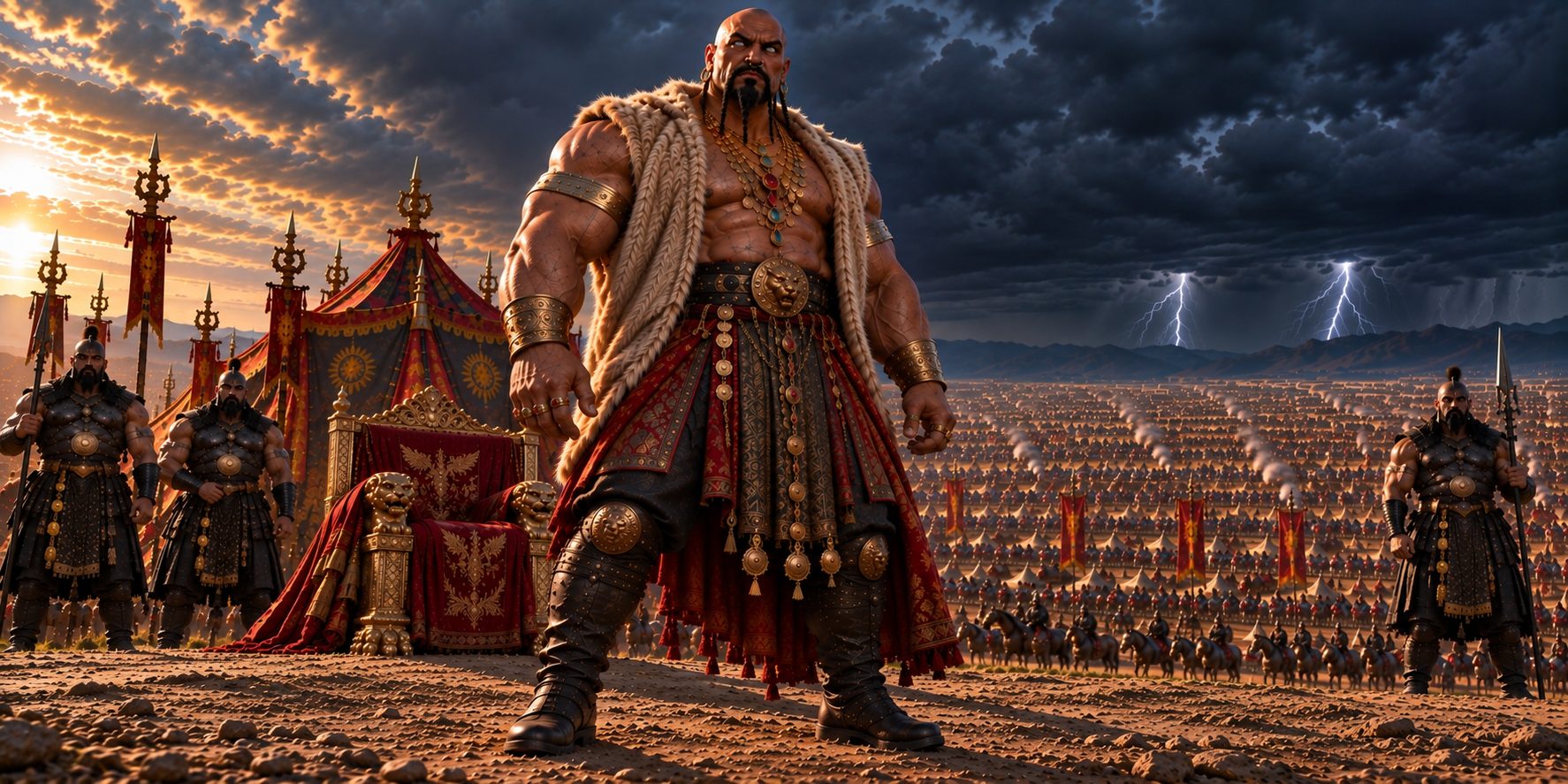
Jagang the Just, as his own people were told to call him
A dream walker does not have to reach you to reach you. He walks into your mind and stays there, behind your eyes, seeing what you see, and the one thing that keeps him out is a bond to the Lord Rahl. The tents behind him are his army, and they run to the horizon whichever way he turns.
The mriswith
Assassins in cloaks that hide them from the eye entirely — beast-like, patient, used as knives. Richard has to learn to see them, and learning to see them is the whole of not dying. There is a rule folded into that, and the books make you find it yourself.
The Beast
A formless hunter sent for Richard out of the underworld in the Chainfire books, which takes a new shape every time it arrives. It is the Keeper’s appetite, given a job of work.
The Scribbly Man
A creature that looks as though it were drawn in furious scribbles and then stood up, out of another world, in The Children of D’Hara — a childhood nightmare made three-dimensional, and the first messenger of the Glee and their Golden Goddess.
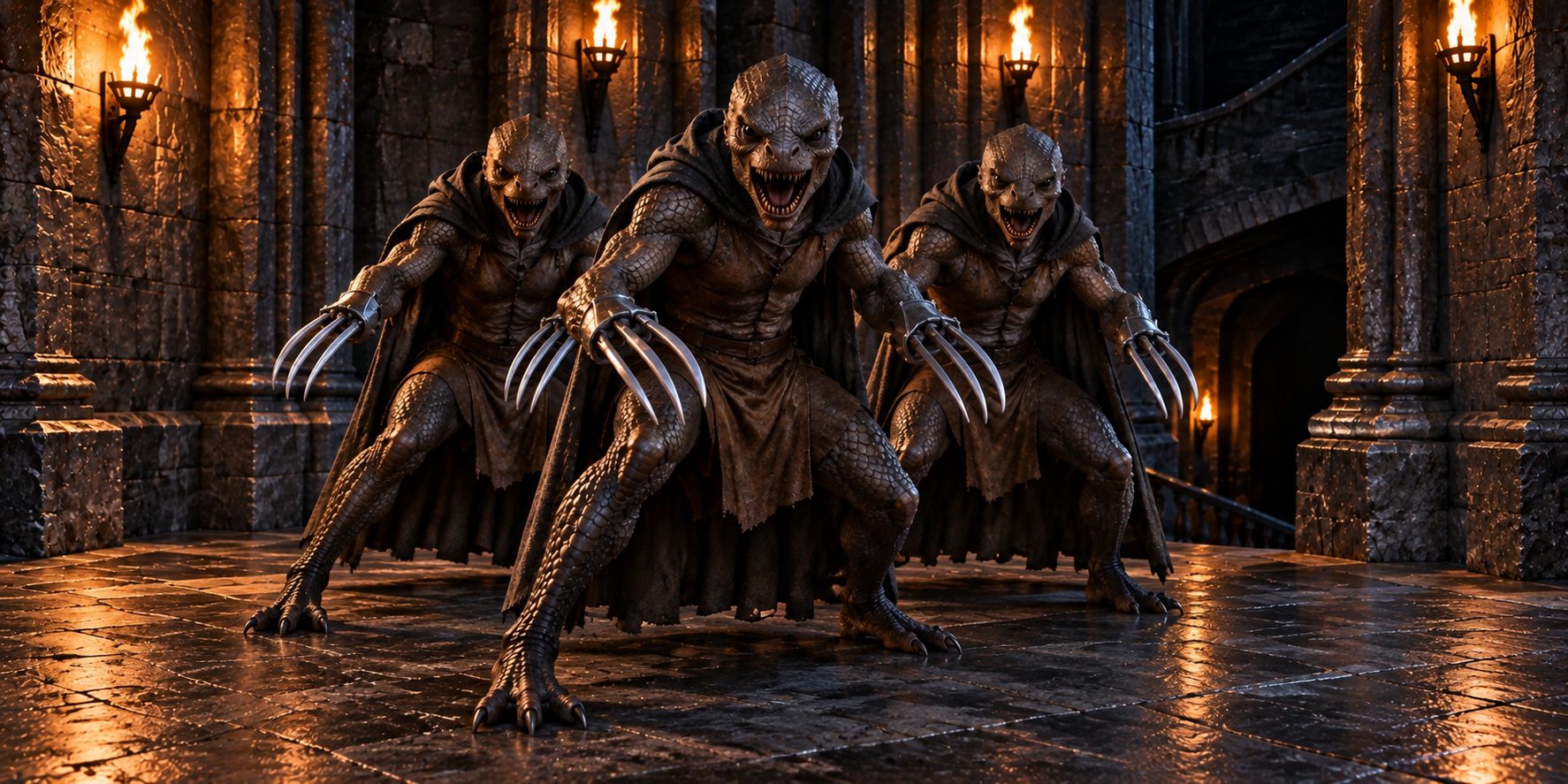
Mriswith. Seeing them is the hard part.
Cape and skin both take the color of whatever is behind them, so a mriswith standing in the open is simply not there to look at; they turn visible in the heat of a fight, which is the only time anyone gets a look like this one. The three blades standing forward from each fist are one knife. Asked who sent it, the first one Richard ever pinned hissed three words, spelled here the way the book spells them: The dreamssss walker.
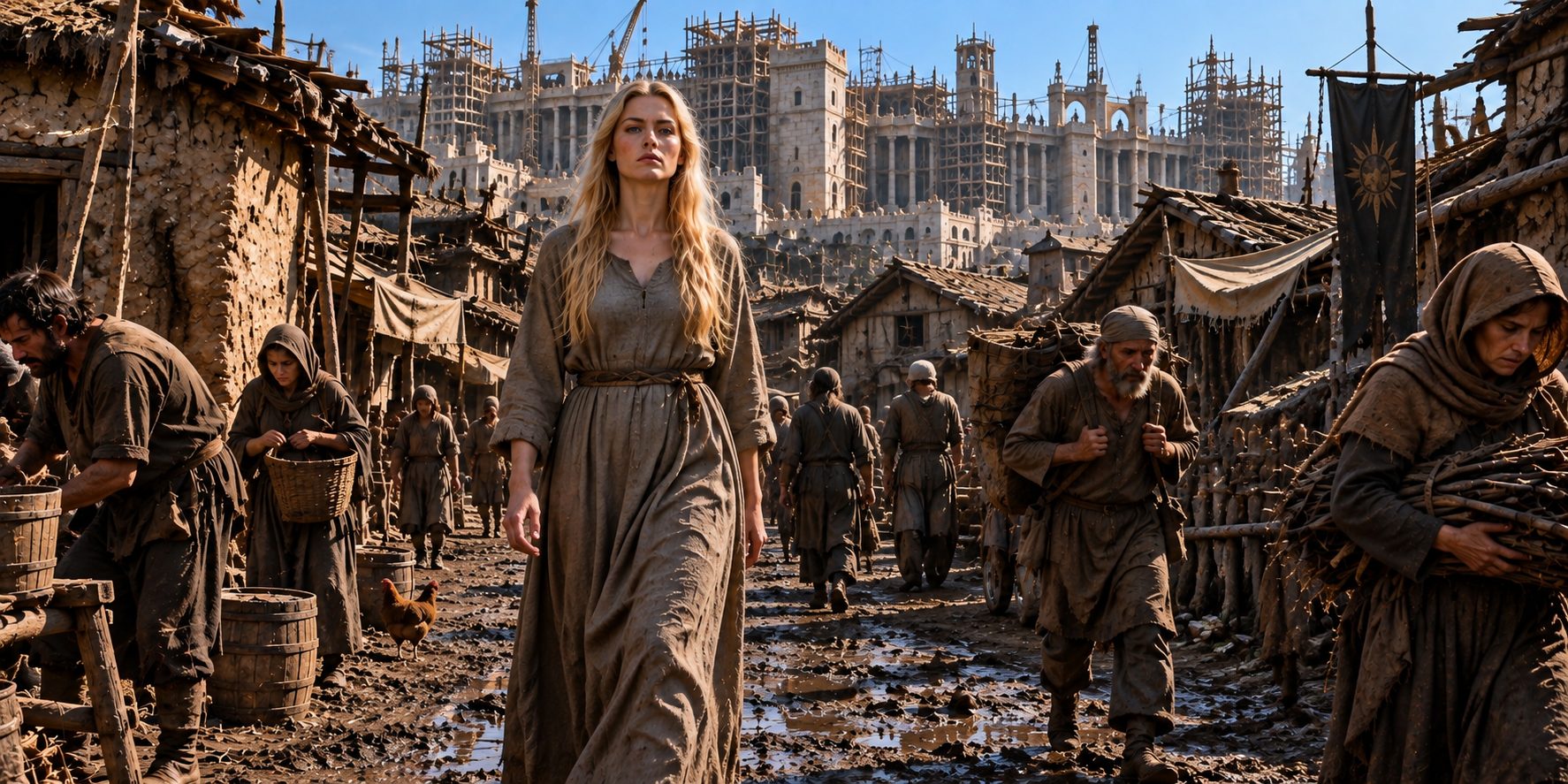
The last stop · the Old World
Altur’Rang
Birthplace of the Order’s doctrine, and the gray city where a laborer buys a block of marble. What happens here is the finest hour the world of the living gets, and no magic is involved in it at all.
Nicci
Once a Sister of the Dark · Death’s Mistress, to people who needed a name for their fear
She takes Richard to the Old World in order to break him, and she is not being cruel for sport: she genuinely believes the doctrine, that man is wretched, that his life is not his own, that wanting anything for yourself is the root of evil. She expects the city to teach him despair. She stays to watch it happen.
What she watches instead is a man take work, save what he earns, buy marble, and carve two figures standing in the light with one word cut into the base of them. Nicci is the series’ long proof that a person can change without pretending their past was pretty. She chose otherwise, and then she kept choosing; the later books are, in large part, hers.
The statue is on the front page of this site, in both of its states, because it is the best short answer to what any of this was for.
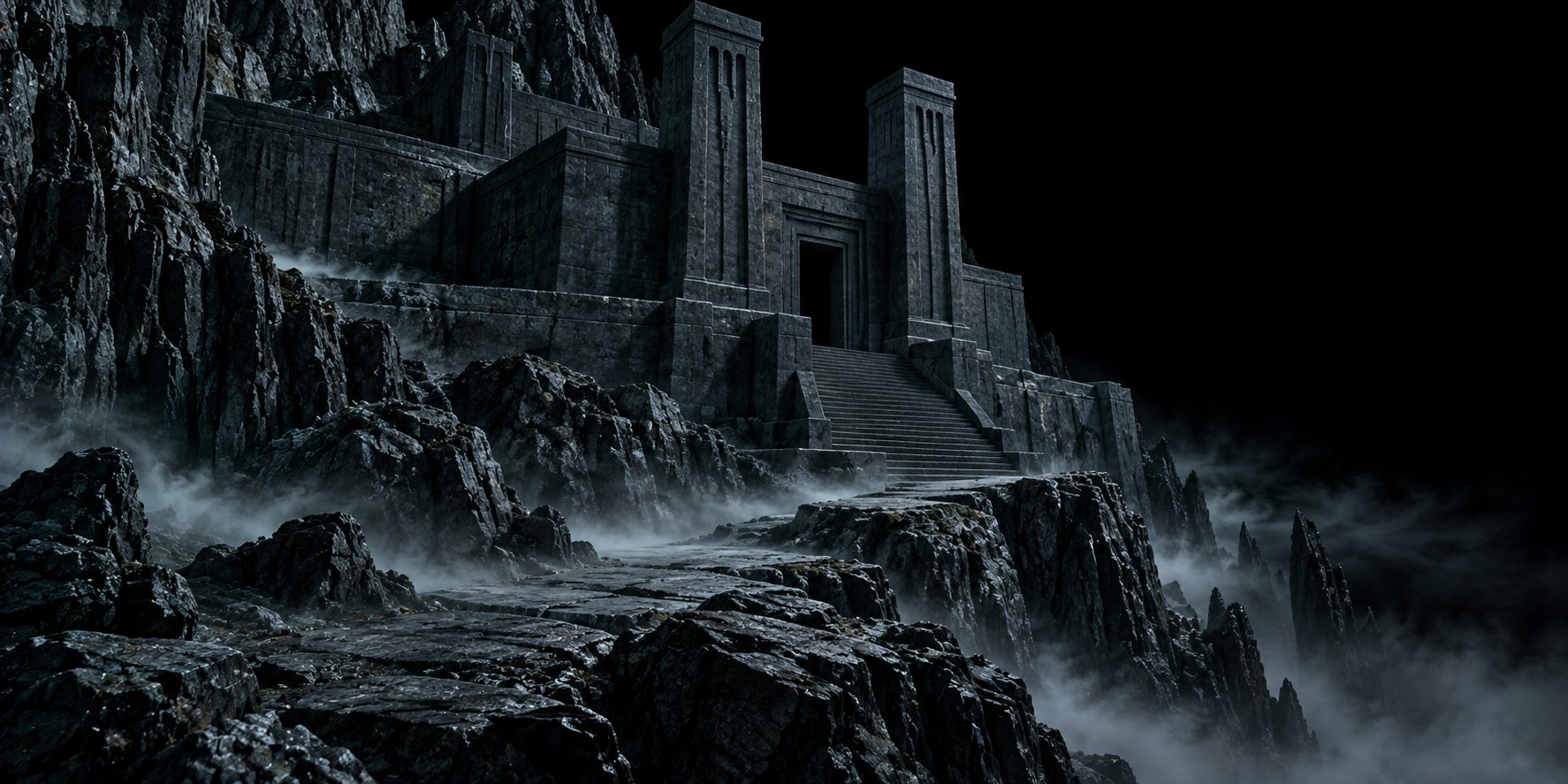
The Temple of the Winds, moved out of the world of the living for safekeeping
The wizards of the great war put the things they judged too dangerous to keep into this temple, and then they sent the temple away. It stood on the top of Mount Kymermosst; now it stands partly in the world of the dead and partly in the world of life. There is no sky over it in the picture because there is no sky where it went.
The rest of the map
Westland, the Midlands, D’Hara; the New World and the Old; the Wilds; Tamarang; Anderith; Bandakar behind its pass; the Dark Lands; Ildakar under its shroud; the Temple of the Winds, which is not in this world at all. The walk stops at eleven because eleven is enough. A man who insisted he did not write fantasy left behind a world with weather in it, and law, and wonder.
The adventure is the walking. What the walking is for is the next chapter.