Skip to the page
Terry Goodkind
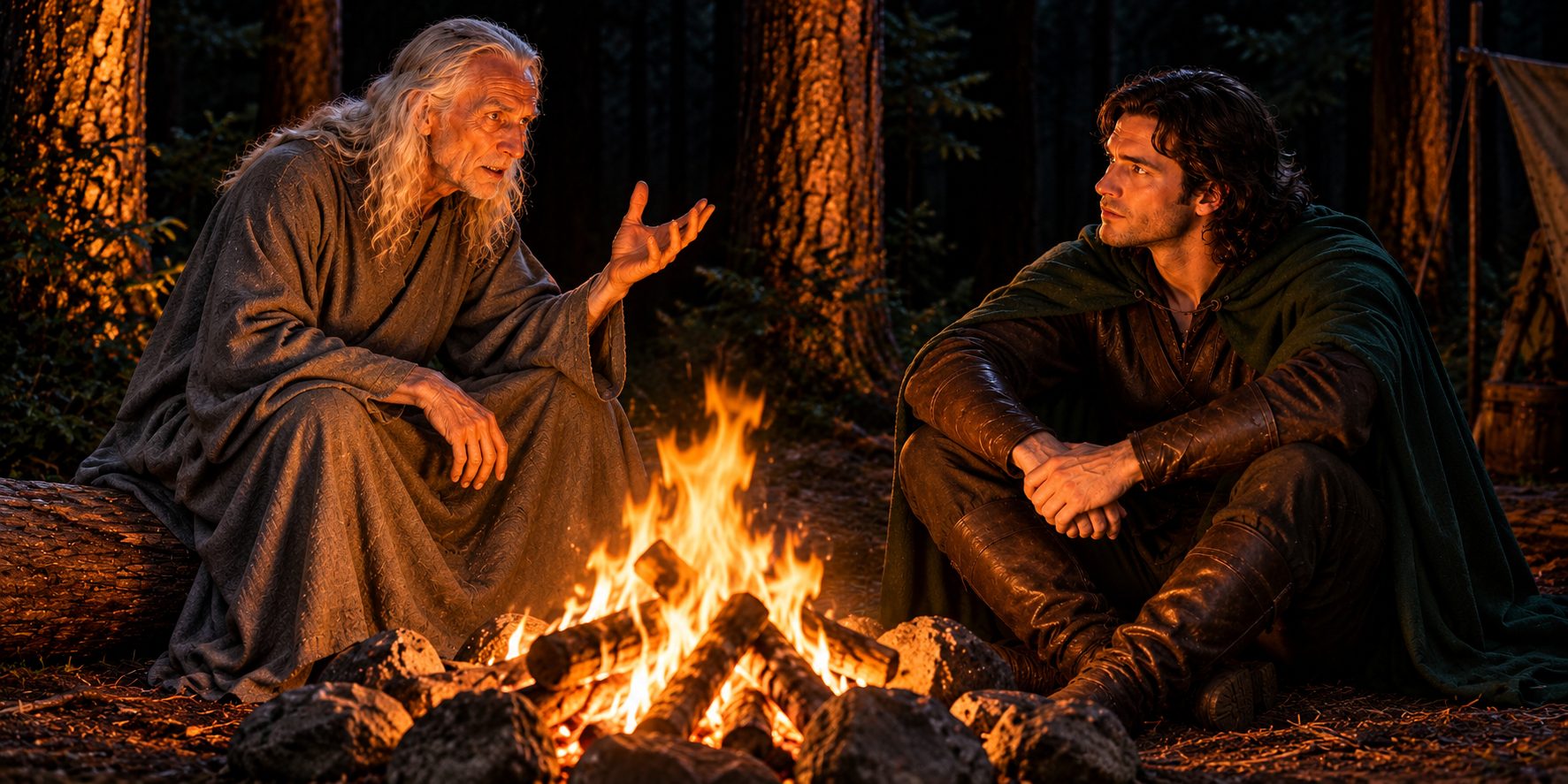
A night camp in a forest: a white-haired old man in a plain robe making a point across a campfire to a young man in a green cloak, both faces lit by the flames

The square · the veil

The Rules

Eleven of them, one to a novel: hard-won lessons about how people can be moved, fooled, healed or ruined by the way they think. They are the most portable thing Goodkind ever wrote, and every one of them works without magic.

What a rule is

A tool small enough to carry

This is the part of the work that escaped the books. Readers who found these novels at fifteen are still quoting them at forty, and what they quote is the rules. A rule is a small tool. It fits in a pocket, and it still works on a Tuesday.

Each of the original Sword of Truth novels is built around one. It is stated somewhere near the middle or the end, usually by someone who has just watched the protagonist learn it the expensive way, and the whole book is the working. That structure is why they stick. The rule arrives as a verdict on six hundred pages you have just lived through.

What follows is the rule, then the book, the chapter where the record is clear, who speaks it, and the circumstance. The long rules are shortened here; the books hold the rest. The First Rule stands exactly as he wrote it, blunt opening word and all.

Evil thinks not to beguile us by unveiling the terrible truth of its festering intent, but comes, instead, disguised in the diaphanous robes of virtue, whispering sweet-sounding lies intended to seduce us into the dark bed of our eternal graves.

Translated from Koloblicin’s Journal · the epigraph to The Pillars of Creation

Wizard’s First Rule

People are stupid.

Given proper motivation, almost anyone will believe almost anything. They will believe a lie because they want to believe it is true, or because they are afraid it might be true. Their heads are full of knowledge, facts and beliefs, and most of it is false, yet they think it all true. They can only rarely tell the difference between a lie and the truth, and yet they are confident they can — and so are all the easier to fool.

Zedd teaches this to Richard after Darken Rahl has already been using it. Give people an enemy, a purpose, a fear or a wish, and they will march. The old wizards made Confessors and Seekers precisely because of it: the truth, when it matters, has to be fought for.

Wizard’s First Rule, chapter 36 · Zeddicus Zu’l Zorander

Wizard’s Second Rule

The greatest harm can result from the best intentions.

Kindness without wisdom is not harmless. Nathan Rahl gives Richard the rule in Stone of Tears, at a point where good motives have already torn the veil and started filling the world of the living with what should have stayed dead.

The counter is knowledge, forethought, and the First Rule — and the book is honest enough to show that even all three together are not always enough. In these novels, meaning well is never a defense.

Stone of Tears, chapter 63 · Nathan Rahl

Wizard’s Third Rule

Passion rules reason.

Found in Kolo’s journal in the Wizard’s Keep, during Blood of the Fold. The rule leaves feeling alone. What it asks is who is driving.

The books keep putting love, rage and faith in the same room as a decision that still has to be thought through, and then watching what happens. Almost every disaster in eleven novels can be traced to somebody who felt something strongly and treated the feeling as evidence.

Blood of the Fold, chapter 43 · Kolo’s journal

Wizard’s Fourth Rule

There is magic in sincere forgiveness.

In the forgiveness you grant, and more so in the forgiveness you receive. This one arrives twice in Temple of the Winds: Shota puts it to Kahlan first, careful about the qualifier in a way a gentler character would not be, since spoken forgiveness without the real thing is theater. Richard receives it from the spirit of Kahlan’s mother, called into a dark room by the Mud People.

Richard and Kahlan have already paid for that distinction by the time it is named. The rule is about healing a life, and it asks the harm to be seen for exactly what it was — which is why it belongs in the same series as a rule about contradictions.

It was an object before it was a sentence. The Sword of Truth has a white blade in it that only comes out when the hate goes out of the man holding it — and in the first book he already knows he will never be able to bring himself to forgive his brother, and so will never make it white for him.

Temple of the Winds, chapter 41 · Shota, and the spirit of Kahlan’s mother

Wizard’s Fifth Rule

Mind what people do, not only what they say.

Deeds betray a lie. Kolo’s journal again, in Soul of the Fire, while Anderith talks eloquently of peace and prepares a rather different kind of surrender.

Watch the hands. The mouth is a poor witness. Of all eleven, this is the one that needs the least translation.

Soul of the Fire, chapter 28 · Kolo’s journal

A single oil lamp on a table of open books and brass instruments, darkness beyond the circle of its light

Halfway

The hinge

The first five rules are about how people fail: they believe what suits them, they do harm meaning well, they let feeling drive, they forgive dishonestly, they listen to words instead of watching hands. The next five are about what to do instead. Everything from here is downstream of the sixth.

Wizard’s Sixth Rule

The only sovereign you can allow to rule you is reason.

What exists, exists. What is, is. Wishes are not a method for finding facts. Richard lives this in Faith of the Fallen long before Zedd names it, and Nicci is forced to stand there and watch a man build a life instead of a sacrifice.

The book holds a longer statement of it. The short one is enough to steer by: do not let anybody — including your own fear — talk you out of the evidence of the world. Every other rule on this page is downstream of this one.

Faith of the Fallen, chapter 41 · Zedd, naming what Richard has already been living

Wizard’s Seventh Rule

Life is the future, not the past.

The past can teach and it can comfort. Only the future holds life. To live in what is already over is to embrace what is dead.

Richard speaks it in The Pillars of Creation, a book almost entirely about people being hunted by yesterday — by a bloodline, a name, a grievance they did not choose. Each day, he says, must be created anew.

The Pillars of Creation, chapter 60 · Richard Rahl

Wizard’s Eighth Rule

Talga Vassternich. Deserve victory.

High D’Haran, cut into the base of Kaja-Rang’s statue in Naked Empire. Be justified in your convictions. Be committed. Earn what you need rather than waiting for the world to hand it over.

It is the racing rule as much as the war rule, and Goodkind spent race days in a cockpit learning it the literal way: the corner does not care that you meant well.

Naked Empire, chapter 61 · inscription on the statue of Kaja-Rang

Wizard’s Ninth Rule

A contradiction cannot exist in reality.

Not in part, nor in whole. To believe one is to give up the world as it is for the world as you wish it. Zedd gives Richard this in Chainfire, when a spell has erased a woman from the memory of everyone alive and the physical evidence still insists she was there.

That is a superb piece of plotting: the rule and the crisis are the same shape. The book holds the rest of the statement, including a hard paragraph on faith as a device of self-delusion. The rule’s own job is simpler — if two claims cannot both be true, do not make peace by calling them both true.

Chainfire, chapter 48 · Zedd

Wizard’s Tenth Rule

Willfully turning aside from the truth is treason to one’s self.

And people who do not want the truth can be remarkably hostile to whoever carries it in. Zedd, in Phantom.

The Seeker’s work and the reader’s turn out to be the same work: do not betray yourself in exchange for a more comfortable story. It is the First Rule turned around to face inward.

Phantom, chapter 12 · Zedd

Wizard’s Eleventh Rule

The rule unwritten.

Baraccus left Richard a book titled The Secrets of a War Wizard’s Power, and every page in it is blank. Zedd explains in Confessor that this was deliberate: the thing cannot be written down, because it only exists in the doing of it.

It can still be worked out. Read what Richard does with it and the unwritten rule comes to roughly this — embrace life; seek strength without hate. It is the only rule on this page you will not find as a sentence in quotation marks anywhere in the series. The line on the banner at the top of this site is one he did write, twice: cut into the base of a sundial in Faith of the Fallen, and again in this same book, as the last thing Richard says before the word End. It is the closest the eleven come to putting their whole case in one sentence. The Eleventh Rule is what you do about it.

Confessor, chapter 59 · Zedd, on Baraccus’s blank book

After the eleven

Unnumbered, and later

The books after Confessor keep producing lines that behave like rules without being given a number. Each one is confirmed inside the story as a Wizard’s Rule — twice by Zedd, once by the Omen Machine — and in each case nobody says which number it is. They stand outside the original eleven, they carry the same weight, and readers quote them the same way.

You can destroy those who speak the truth, but you cannot destroy the truth itself.

The Omen Machine, chapter 70 · spoken by the machine, confirmed by Zedd

There have always been those who hate, and there always will be.

Severed Souls, chapter 47 · confirmed by Zedd

In this world, everyone must die. None of us has any choice in that. Our choice is how we wish to live.

Warheart, chapter 52 · confirmed by the Omen Machine

Read the eleven together and the last one turns out to be the one that carries the others. Ten rules can be stated, argued with, written on a wall. The eleventh declines to be written at all, because the only place the whole thing exists is in what somebody actually does with their days.

That is the whole of thirty-two books, and it fits on a page. He did not put it on a page. He put it in a story, which is the form most people can actually receive it in.

the outer circle · next chapter The Legacy What was said when he died, by a novelist, a bookshop and a friend. The last book he saw published, and the two that were printed without him.