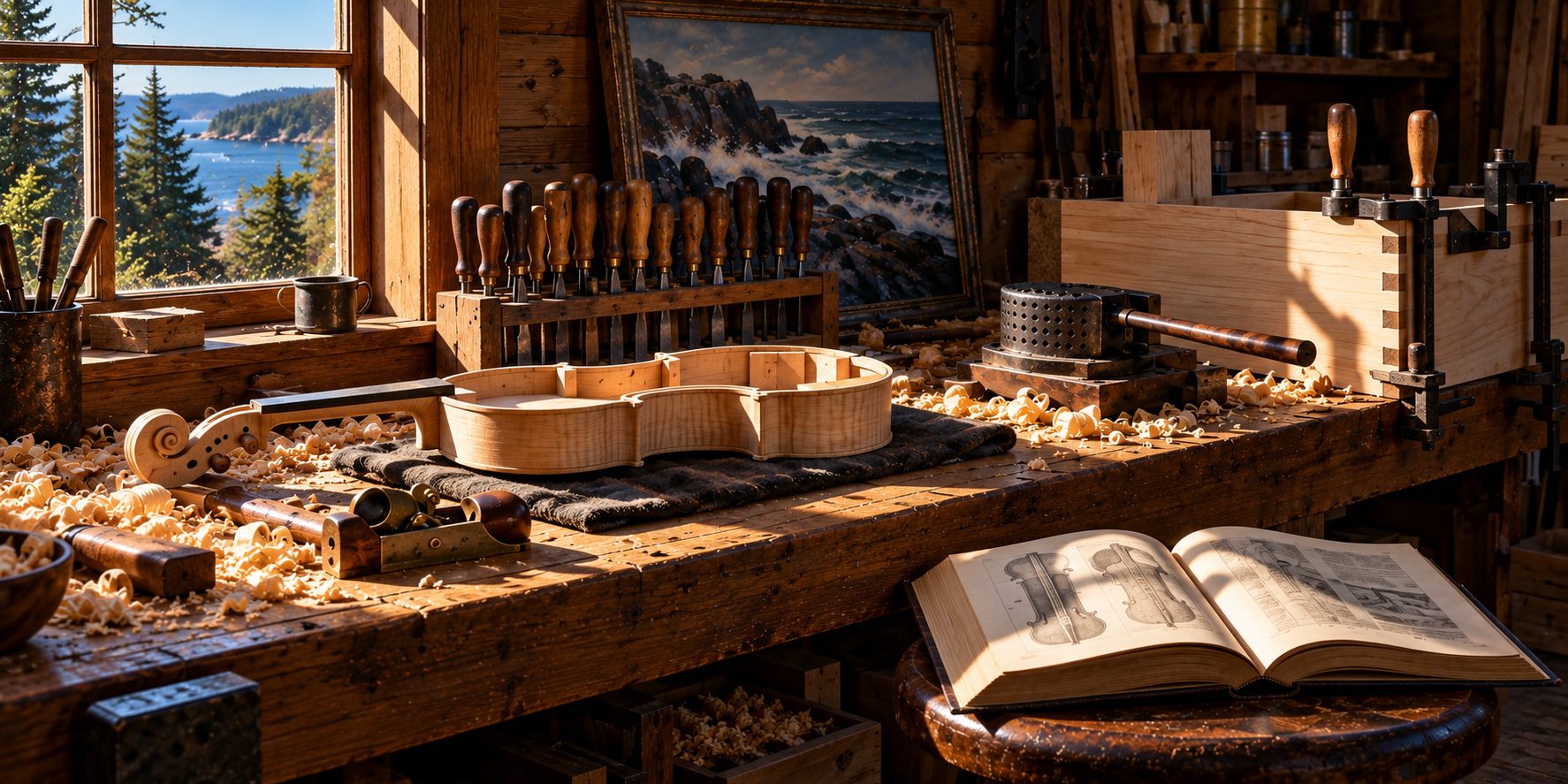
The star at the center · the gift
The Gift
He made things with his hands for forty-five years before he made a novel. Cabinets. Violins. Paintings of the sea. Then a house on an island in Maine, and while it was still going up, a book about an odd-looking vine.
The star at the center
Why the chapter is called that
In the novels, the gift is a technical term and nothing grander. It means magic born in a person: not studied, not bought, not asked for, and dangerous to whoever carries it until somebody teaches them how. Richard has it and does not know it. Zedd has it and hides it. The word is used the way anyone uses it about an inherited talent, and the books mean it literally.
Goodkind had one too, and it was in his hands a long time before it was in his sentences. Cabinets. Violins. Paintings sold in galleries. A house he spent nine years building. He said all his life that written words came hard to him, and he told stories anyway, and nobody taught him to do that either.
Then there is the third meaning, which is the one he cared about: life is the gift each of us has been given. It is the passage at the foot of this page, and it is what the single word cut into the base of the statue in Faith of the Fallen is there to say. Three uses of one word, and this chapter is the star at the center of the Grace because all three of them start there.
1948 – 2020
The life, as the record has it
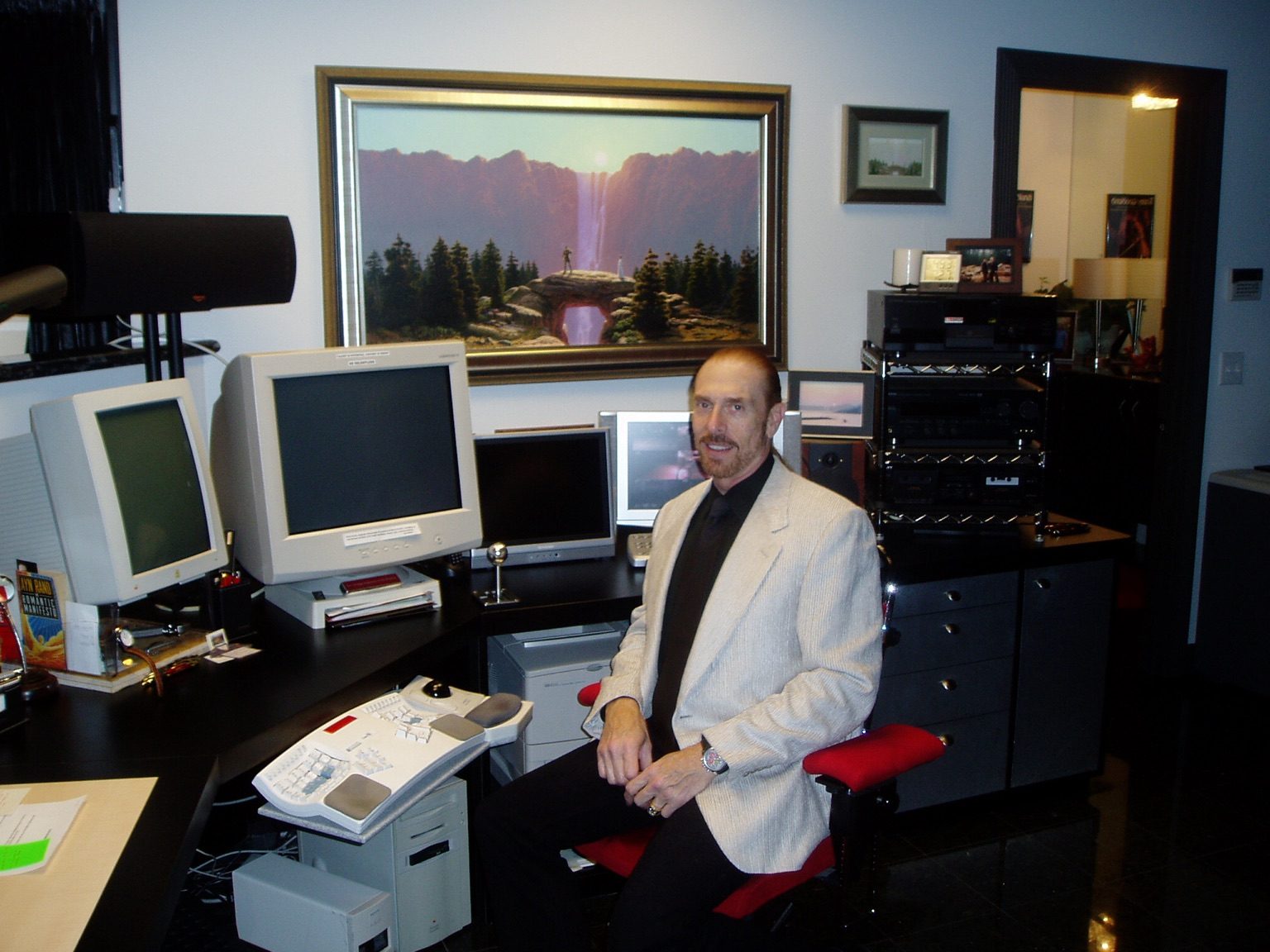
Terry Lee Goodkind was born in Omaha, Nebraska, on 11 January 1948. He died on 17 September 2020, at his home in Boulder City, Nevada, aged seventy-two. The cause was not made public.
Everything on this page comes from public sources: interviews he gave, his own website, and the notices published when he died. Those sources are short on private detail, and they are still enough, because the shape of the story is unmistakable: a person who was told early that one door was shut to him, went and found another, and then spent the rest of his life walking through it.
Stories in the head
His parents, Leo and Natalie Goodkind, ran a direct-mail business in Omaha. The stories started before anything else did. “I’m a born storyteller,” he said. “My earliest memories are of telling myself stories. I lived with the characters from the stories in my head. When I was little I remember playing in the backyard, writing and directing plays for the other kids in the neighborhood.”
“I have dyslexia,” he told an interviewer in 2007, “so written words have always been something that have given me difficulty.” He did not read much as a boy. He made things up instead. “I’d go to sleep at night dreaming up stories about characters that were in trouble,” he told the Las Vegas Review-Journal in 2016, “and I’d imagine what they were afraid of and how they got out of trouble, how they’d solve whatever the problem was.”
He came to novels from the inside. “I can’t even remember the last time I read a novel,” he said in that same 2007 interview. “I rarely read novels, partially because I have dyslexia; it takes me a long time to read.” He read nonfiction instead, and said he did not want to be distracted by how other authors did things.
That is why his prose sounds like nobody else’s. It came out of the inside of a man’s own head instead of off a shelf.
The hands
Before the books he made things. He went to art school in Omaha, one of many interests on the way to the books. Cabinets. Violins. Paintings of the sea and of animals, sold in galleries — marine as in water and wildlife, not as in a uniform. He and Jeri moved to Mount Desert Island in Maine in the mid-1980s, and he spent nine years building their house in the forest there.
Remember those nine years when you reach the statue in Faith of the Fallen. When Richard picks up a chisel in a country that has been taught it is worthless, the man writing the scene had spent years learning what a chisel actually does.
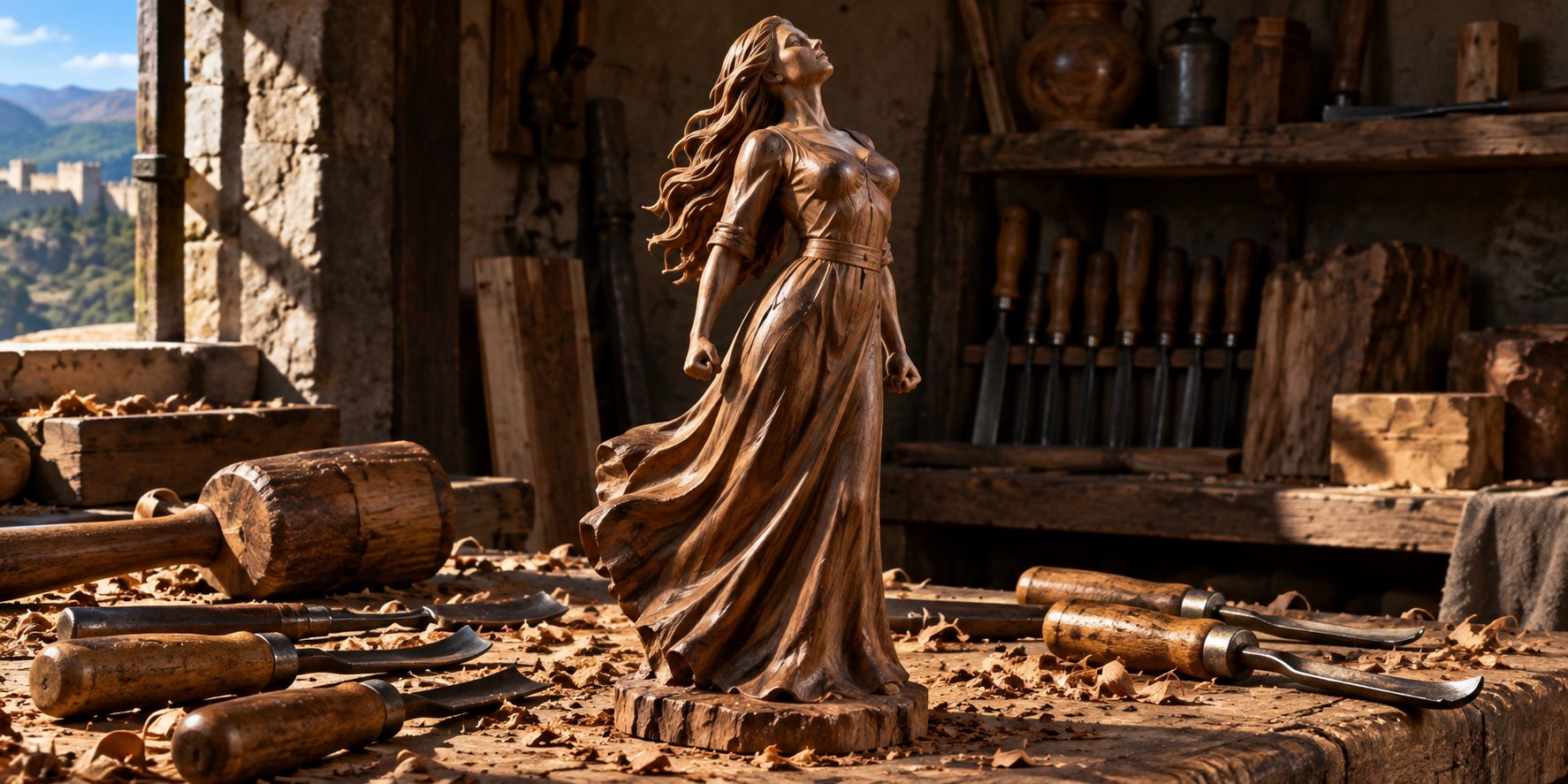
Spirit
Not a scene from the story, but an object inside it. Richard carves through Kahlan’s long convalescence in a mountain house, and gives her this one from walnut in celebration of her getting well enough to come out into the world: head thrown back, back arched, fists closed at her sides in defiance of anything that would think to bridle her. Zedd knows it on sight. The boy carved a statue of your spirit. I recognize it. It’s as plain as day.
Forty-five
There, on the island, with the new house still coming together, he began Wizard’s First Rule. He was forty-five years old and it was the first novel he had ever put on paper. “It’s always been my dream to write novels, so when I decided it was time, I had this character in my head — Kahlan,” he said. “I was finishing building our home in Maine, so I decided that was the time, and I was thinking about Kahlan during the entire time I finished the house, so after that, I started writing.”
He said he had no larger plan than pleasure: he “just wanted to write a story and entertain myself and have a great time.” Partway through it he looked at what he had and thought, “This is really good.” Then he sent it to the best agent he could find.
Tor bought it at auction for a then-record advance of $275,000 and published it in 1994, the year he turned forty-six. Forty-five when he wrote it, forty-six when the world could read it — and then he wrote for the next twenty-six years without a break.
From the record
Seven things he said, or did
Goodkind did not scatter autobiography. What follows comes from interviews he gave, his own site, and the public record.
He said he did not write fantasy
He said it plainly, more than once, and it is the key to reading him. “When I was writing Sword of Truth, I wasn’t writing fantasy,” he told the Review-Journal. “I was writing a story about characters in great trouble and characters sharing the same kinds of problems we all have.” The magic came in because of the scale he wanted: “The story I was telling needed a broad landscape. It needed to be a grand epic.”
So the magic behaves like physics. Additive magic adds to what exists. Subtractive magic takes away. Wizard’s fire is heat drawn out of the air and piled into a shape. The Boundary is underworld, raised as a wall. And every bit of it is there to hold up the people standing in it.
Ayn Rand, by his own account
The philosophical influence he named was Ayn Rand, especially her nonfiction on how the mind forms concepts, and he called her the greatest thinker since Aristotle. He was direct about his own position: “I’m an Objectivist, and I have a lot of Objectivist thinking through Richard.” And just as direct about the limits of it. “I’m not trying to teach Objectivism in books; these are just fun stories… My purpose is to tell a fun story, not to be a philosophy teacher.”
And he described his own books in plainer terms than any school of philosophy: “My stories are the American ideal of life, liberty and the pursuit of happiness,” he said in 2007 — “our struggle for freedom, our struggle for independence, our struggle for individual liberty and people ruled by reason.”
The hours were the method
“I’m writing 15 hours a day, seven days a week,” he said in 2007. It reads less like a boast than like a description of where he preferred to be. Jeri, the animals, and a few days a year on a racetrack: that is the life he described outside the writing.
Rahl Racing
He called himself an avid race car driver, and he meant it in the way that involves a helmet. He drove a Radical SR8 — a genuine sports-racing car — as car number 14 for his own team, Rahl Racing, mostly at Spring Mountain Motorsports Ranch outside Las Vegas. He took the 2011 Radical Racing Unlimited Series championship. Readers who turned up at the track sometimes went home having been driven around it by him, in the passenger seat.
The Eighth Rule reads like something learned at speed: deserve victory. The corner does not care that you meant well.
He kept writing to the end
The Sword of Truth sold more than twenty-five million copies and was translated into more than twenty languages. Phantom reached number one on the New York Times list; Confessor and Chainfire both landed in the top three. And the number worth keeping is a different one: twenty-six years of it, from a man who started at forty-five. Three of his books came out in 2020, the year he died.
He published one of them himself
On 2 July 2012 he self-published The First Confessor: The Legend of Magda Searus as an ebook, with three hundred individually numbered collector hardcovers besides — the origin story of the series, brought out under his own hand. By the next morning it was number 28 on the Kindle bestseller list.
Then it was pirated, and he did something a lot of authors would not: he named an alleged uploader on Facebook, with a photograph and personal details. It became a public row, and not everyone who admired the books admired the tactic. It is part of the record, and it belongs here with the rest of it: he was not a careful man about his own convictions.
Television, and the fine print
He had turned down offers for the rights more than once, because he did not trust other producers to keep his characters intact. Sam Raimi got a yes. Raimi’s partner Joshua Donen pushed the books at him, Raimi read them, and after talking to Goodkind he dropped the idea of a film in favor of a weekly series, because a series had room for the story. Legend of the Seeker premiered on 1 November 2008, ran forty-four episodes across two seasons, was shot entirely in New Zealand, drew more than four million viewers over its first weekend, and won an Emmy for its music. Retitling it away from Wizard’s First Rule was Goodkind’s own suggestion, so that nobody would sit down expecting the book.
Before production he wrote to his readers that Raimi’s team wanted to keep the show true to his vision, “so rest assured that I am going to be intimately involved in the writing of each of the episodes.” Once it was being made, he wrote to them again. “I want you all to understand that ABC studios chose not to consult me on actors, scripts, or any other aspect of the show,” he said. “I have had no input whatsoever on the TV series, so I am the wrong person to write to or complain about the show.” He stayed generous about Raimi and Tapert regardless, and when the show was cancelled in 2010 and readers started a campaign to bring it back, he backed them.

To exist in this vast universe for a speck of time is the great gift of life. Our tiny sliver of time is our gift of life. It is our only life. The universe will go on, indifferent to our brief existence, but while we are here we touch not just part of that vastness, but also the lives around us. Life is the gift each of us has been given. Each life is our own and no one else’s. It is precious beyond all counting. It is the greatest value we can have. Cherish it for what it truly is… Your life is yours alone. Rise up and live it.
The end of the file
What he kept
Later they moved to Nevada, and it was in Boulder City that he died. He raced. He wrote. When he died, the public was told the date, the place, and that Jeri survived him.
He was uncompromising about ideas, and some readers pushed back — at the later books, at the philosophy on the page, at the man in public. Those disagreements are real and this tribute does not pretend otherwise. It also has no interest in refighting them. The biography here stops where the public record does: at the work, the craft, the marriage, and the fact of a life that was his own.
Which leaves the part he did hand over. Thirty-two books. A Keep readers can still see with their eyes closed. Eleven rules people quote at forty who first read them at fifteen. And one sentence he thought well enough of to write twice — once into stone, and once as the last words of the last book — which is easier to live by than most philosophies half its length.
Your life is yours alone. Rise up and live it.